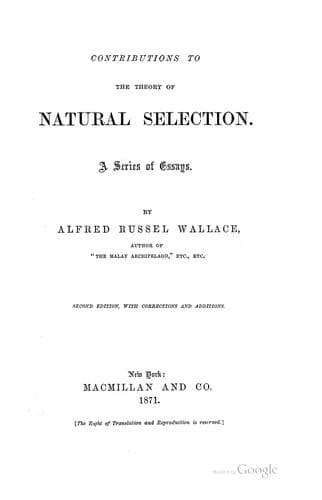
Contributions to the Theory of Natural Selection: A Series of EssaysWallace, Alfred Russel
Science
Contributions to the Theory of Natural Selection: A Series of Essays
Wallace, Alfred Russel
Natural selection
M. Pouchet thinks that the new form is an undoubted improvement on the
old. The nest has a wider bottom and must allow the young ones to have
more freedom of motion than in the old narrower, and deeper nests, and
its wide aperture allows the young birds to peep out and breathe the
fresh air. This is so wide as to serve as a sort of balcony for them,
and two young ones can often be seen on it without interfering with the
passage in and out of the old birds. At the same time, by being so close
to the roof, it is a better protection against rain, against cold, and
against enemies, than the small round hole of the old nests. Here, then,
we have an improvement in nest building, as well marked as any
improvement that takes place in human dwellings in so short a time.
But perfection of structure and adaptation to purpose, are not universal
characteristics of birds' nests, since there are decided imperfections
in the nesting of many birds which are quite compatible with our present
theory, but are hardly so with that of instinct, which is supposed to be
infallible. The Passenger pigeon of America often crowds the branches
with its nests till they break, and the ground is strewn with shattered
nests, eggs, and young birds. Rooks' nests are often so imperfect that
during high winds the eggs fall out; but the Window-Swallow is the most
unfortunate in this respect, for White, of Selborne, informs us that he
has seen them build, year after year, in places where their nests are
liable to be washed away by a heavy rain and their young ones destroyed.
_Conclusion._
Public-domain text, read in full here on John Shaqi.
Reviews
Reviews
No reviews yet
Be the first to share your thoughts on this work.
Elsewhere in the archive
Join the Discussion
Join the discussion
Sign in to leave a comment or review.
Sign InorCreate an account