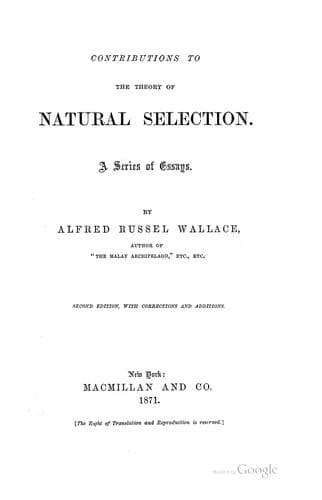
Contributions to the Theory of Natural Selection: A Series of EssaysWallace, Alfred Russel
Science
Contributions to the Theory of Natural Selection: A Series of Essays
Wallace, Alfred Russel
Natural selection
A curious example of a recent change of habits has occurred in Jamaica.
Previous to 1854, the palm swift (Tachornis phaenicobea) inhabited
exclusively the palm trees in a few districts in the island. A colony
then established themselves in two cocoa-nut palms in Spanish Town, and
remained there till 1857, when one tree was blown down, and the other
stripped of its foliage. Instead of now seeking out other palm trees,
the swifts drove out the swallows who built in the Piazza of the House
of Assembly, and took possession of it, building their nests on the tops
of the end walls and at the angles formed by the beams and joists, a
place which they continue to occupy in considerable numbers. It is
remarked that here they form their nest with much less elaboration than
when built in the palms, probably from being less exposed.
A still more curious example of change and improvement in nest building
was published by Mr. F. A. Pouchet, in the tenth number of the _Comptes
Rendus_ for 1870, just as the first edition of this work appeared. Forty
years ago M. Pouchet had himself collected nests of the House-Martin or
Window-Swallow (_Hirundo urbica_) from old buildings at Rouen, and
deposited them in the museum of that city. On recently obtaining some
more nests he was surprised, on comparing them with the old ones, to
find that they exhibited a decided change of form and structure. This
led him to investigate the matter more closely. The changed nests had
been obtained from houses in a newly erected quarter of the city, and he
found that all the nests in the newly-built streets were of the new
form. But on visiting the churches and older buildings, and some rocks
where these birds build, he found many nests of the old type along with
some of the new pattern. He then examined all the figures and
descriptions of the older naturalists, and found that they invariably
represented the older form only.
The difference between the two forms he states to be as follows. In the
old form the nest is a portion of a globe--when situated in the upper
angle of a window one-fourth of a hemisphere--and the opening is very
small and circular, being of a size just sufficient to allow the body of
the bird to pass. In the new form the nest is much wider in proportion
to its height, being a segment of a depressed spheroid, and the aperture
is very wide and shallow, and close to the horizontal surface to which
the nest is attached above.
Public-domain text, read in full here on John Shaqi.
Reviews
Reviews
No reviews yet
Be the first to share your thoughts on this work.
Elsewhere in the archive
Join the Discussion
Join the discussion
Sign in to leave a comment or review.
Sign InorCreate an account