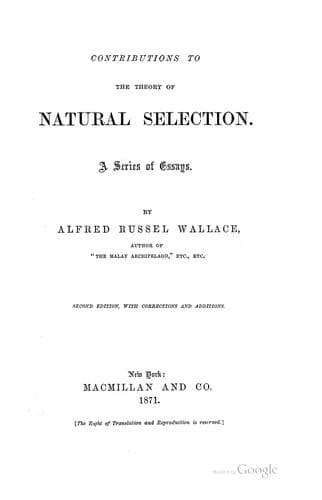
Contributions to the Theory of Natural Selection: A Series of EssaysWallace, Alfred Russel
Science
Contributions to the Theory of Natural Selection: A Series of Essays
Wallace, Alfred Russel
Natural selection
For the purpose of this inquiry it is necessary to group nests into two
great classes, without any regard to their most obvious differences or
resemblances, but solely looking to the fact of whether the contents
(eggs, young, or sitting bird) are hidden or exposed to view. In the
first class we place all those in which the eggs and young are
completely hidden, no matter whether this is effected by an elaborate
covered structure, or by depositing the eggs in some hollow tree or
burrow underground. In the second, we group all in which the eggs,
young, and sitting bird are exposed to view, no matter whether there is
the most beautifully formed nest, or none at all. Kingfishers, which
build almost invariably in holes in banks; Woodpeckers and Parrots,
which build in hollow trees; the Icteridae of America, which all make
beautiful covered and suspended nests; and our own Wren, which builds a
domed nest, are examples of the former; while our Thrushes, Warblers,
and Finches, as well as the Crowshrikes, Chatterers, and Tanagers of the
tropics, together with all Raptorial birds and Pigeons, and a vast
number of others in every part of the world, all adopt the latter mode
of building.
It will be seen that this division of birds according to their
nidification, bears little relation to the character of the nest itself.
It is a functional not a structural classification. The most rude and
the most perfect specimens of bird-architecture are to be found in both
sections. It has, however, a certain relation to natural affinities, for
large groups of birds, undoubtedly allied, fall into one or the other
division exclusively. The species of a genus or of a family are rarely
divided between the two primary classes, although they are frequently
divided between the two very distinct modes of nidification that exist
in the first of them.
All the Scansorial or climbing, and most of the Fissirostral or
wide-gaped birds, for example, build concealed nests; and, in the latter
group, the two families which build open nests, the Swifts and the
Goat-suckers, are undoubtedly very widely separated from the other
families with which they are associated in our classifications. The
Tits vary much in their mode of nesting, some making open nests
concealed in a hole, while others build domed or even pendulous covered
nests, but they all come under the same class. Starlings vary in a
similar way. The talking Mynahs, like our own starlings, build in holes,
the glossy starlings of the East (of the genus Calornis) form a hanging
covered nest, while the genus Sturnopastor builds in a hollow tree. One
of the most striking cases in which one family of birds is divided
between the two classes, is that of the Finches; for while most of the
European species build exposed nests, many of the Australian finches
make them dome-shaped.
_Sexual differences of Colour in Birds._
Public-domain text, read in full here on John Shaqi.
Reviews
Reviews
No reviews yet
Be the first to share your thoughts on this work.
Elsewhere in the archive
Join the Discussion
Join the discussion
Sign in to leave a comment or review.
Sign InorCreate an account