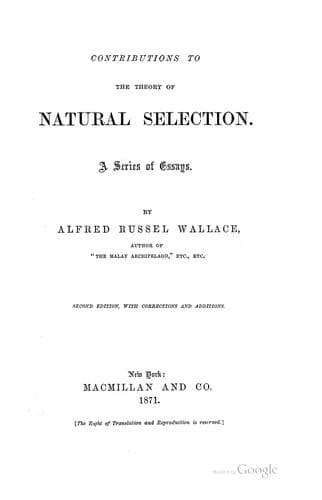
Contributions to the Theory of Natural Selection: A Series of EssaysWallace, Alfred Russel
Science
Contributions to the Theory of Natural Selection: A Series of Essays
Wallace, Alfred Russel
Natural selection
Turning now from the nests to the creatures who make them, let us
consider birds themselves from a somewhat unusual point of view, and
form them into separate groups, according as both sexes, or the males
only, are adorned with conspicuous colours.
The sexual differences of colour and plumage in birds are very
remarkable, and have attracted much attention; and, in the case of
polygamous birds, have been well explained by Mr. Darwin's principle of
sexual selection. We can, to a great extent, understand how male
Pheasants and Grouse have acquired their more brilliant plumage and
greater size, by the continual rivalry of the males both in strength and
beauty; but this theory does not throw any light on the causes which
have made the female Toucan, Bee-eater, Parroquet, Macaw and Tit, in
almost every case as gay and brilliant as the male, while the gorgeous
Chatterers, Manakins, Tanagers, and Birds of Paradise, as well as our
own Blackbird, have mates so dull and inconspicuous that they can hardly
be recognised as belonging to the same species.
_The Law which connects the Colours of Female Birds with the mode of
Nidification._
The above-stated anomaly can, however, now be explained by the influence
of the mode of nidification, since I find that, with but very few
exceptions, it is the rule--_that when both sexes are of strikingly gay
and conspicuous colours, the nest is of the first class, or such as to
conceal the sitting bird; while, whenever there is a striking contrast
of colours, the male being gay and conspicuous, the female dull and
obscure, the nest is open and the sitting bird exposed to view_. I will
now proceed to indicate the chief facts that support this statement, and
will afterwards explain the manner in which I conceive the relation has
been brought about.
We will first consider those groups of birds in which the female is
gaily or at least conspicuously coloured, and is in most cases exactly
like the male.
1. Kingfishers (Alcedinidae). In some of the most brilliant species of
this family the female exactly resembles the male; in others there is a
sexual difference, but it rarely tends to make the female less
conspicuous. In some, the female has a band across the breast, which is
wanting in the male, as in the beautiful Halcyon diops of Ternate. In
others the band is rufous in the female, as in several of the American
species; while in Dacelo gaudichaudii, and others of the same genus, the
tail of the female is rufous, while that of the male is blue. In most
kingfishers the nest is in a deep hole in the ground; in Tanysiptera it
is said to be in a hole in the nests of termites, or sometimes in
crevices under overhanging rocks.
2. Motmots (Momotidae). In these showy birds the sexes are exactly alike,
and the nest in a hole under ground.
3. Puff-birds (Bucconidae). These birds are often gaily coloured; some
have coral-red bills; the sexes are exactly alike, and the nest is in a
hole in sloping ground.
Public-domain text, read in full here on John Shaqi.
Reviews
Reviews
No reviews yet
Be the first to share your thoughts on this work.
Elsewhere in the archive
Join the Discussion
Join the discussion
Sign in to leave a comment or review.
Sign InorCreate an account