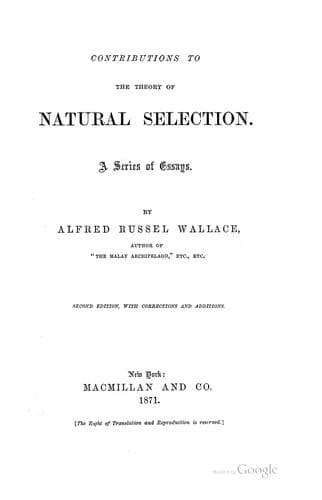
Contributions to the Theory of Natural Selection: A Series of EssaysWallace, Alfred Russel
Science
Contributions to the Theory of Natural Selection: A Series of Essays
Wallace, Alfred Russel
Natural selection
We find, therefore, that a very large mass of facts relating to the
sexual colouration and the mode of nidification of birds, including some
of the most extraordinary anomalies to be found in their natural
history, can be shown to have an interdependent relation to each other,
on the simple principle of the need of greater protection to that parent
which performs the duties of incubation. Considering the very imperfect
knowledge we possess of the habits of most extra-European birds, the
exceptions to the prevalent rule are few, and generally occur in
isolated species or in small groups; while several apparent exceptions
can be shown to be really confirmations of the law.
_Real or apparent Exceptions to the Law stated at page 240._
The only marked exceptions I have been able to discover are the
following:--
1. King crows (Dicrourus). These birds are of a glossy black colour with
long forked tails. The sexes present no difference, and they build open
nests. This apparent exception may probably be accounted for by the fact
that these birds do not need the protection of a less conspicuous
colour. They are very pugnacious, and often attack and drive away crows,
hawks, and kites; and as they are semi-gregarious in their habits, the
females are not likely to be attacked while incubating.
2. Orioles (Oriolidae). The true orioles are very gay birds; the sexes
are, in many Eastern species, either nearly or quite alike, and the
nests are open. This is one of the most serious exceptions, but it is
one that to some extent proves the rule; for in this case it has been
noticed, that the parent birds display excessive care and solicitude in
concealing the nest among thick foliage, and in protecting their
offspring by incessant and anxious watching. This indicates that the
want of protection consequent on the bright colour of the female makes
itself felt, and is obviated by an increased development of the mental
faculties.
3. Ground thrushes (Pittidae). These elegant and brilliantly-coloured
birds are generally alike in both sexes, and build an open nest. It is
curious, however, that this is only an apparent exception, for almost
all the bright colours are on the under surface, the back being usually
olive green or brown, and the head black, with brown or whitish stripes,
all which colours would harmonize with the foliage, sticks, and roots
which surround the nest, built on or near the ground, and thus serve as
a protection to the female bird.
Public-domain text, read in full here on John Shaqi.
Reviews
Reviews
No reviews yet
Be the first to share your thoughts on this work.
Elsewhere in the archive
Join the Discussion
Join the discussion
Sign in to leave a comment or review.
Sign InorCreate an account