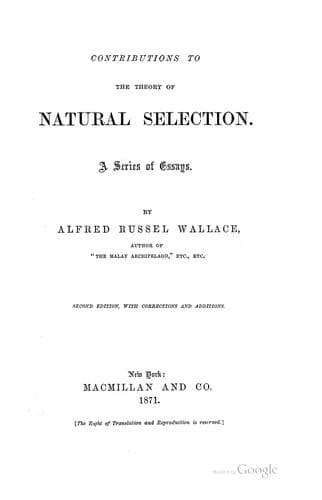
Contributions to the Theory of Natural Selection: A Series of EssaysWallace, Alfred Russel
Science
Contributions to the Theory of Natural Selection: A Series of Essays
Wallace, Alfred Russel
Natural selection
There exist a few very curious and anomalous facts in the natural
history of birds, which fortunately serve as crucial tests of the truth
of this mode of explaining the inequalities of sexual colouration. It
has been long known, that in some species the males either assisted in,
or wholly performed, the act of incubation. It has also been often
noticed, that in certain birds the usual sexual differences were
reversed, the male being the more plainly coloured, the female more gay
and often larger. I am not, however, aware that these two anomalies had
ever been supposed to stand to each other in the relation of cause and
effect, till I adduced them in support of my views of the general theory
of protective adaptation. Yet it is undoubtedly the fact, that in the
best known cases in which the female bird is more conspicuously coloured
than the male, it is either positively ascertained that the latter
performs the duties of incubation, or there are good reasons for
believing such to be the case. The most satisfactory example is that of
the Gray Phalarope (Phalaropus fulicarius), the sexes of which are alike
in winter, while in summer the female instead of the male takes on a gay
and conspicuous nuptial plumage; but the male performs the duties of
incubation, sitting upon the eggs, which are laid upon the bare ground.
In the Dotterell (Eudromias morinellus) the female is larger and more
brightly coloured than the male; and here, also, it is almost certain
that the latter sits upon the eggs. The Turnices of India also, have the
female larger and often more brightly coloured; and Mr. Jerdon states,
in his "Birds of India," that the natives report, that, during the
breeding season, the females desert their eggs and associate in flocks,
while the males are employed in hatching the eggs. In the few other
cases in which the females are more brightly coloured, the habits are
not accurately known. The case of the Ostriches and Emeus will occur to
many as a difficulty, for here the male incubates, but is not less
conspicuous than the female; but there are two reasons why the case does
not apply;--the birds are too large to derive any safety from
concealment, from enemies which would devour the eggs they can defend
themselves by force, while to escape from their personal foes they trust
to speed.
Public-domain text, read in full here on John Shaqi.
Reviews
Reviews
No reviews yet
Be the first to share your thoughts on this work.
Elsewhere in the archive
Join the Discussion
Join the discussion
Sign in to leave a comment or review.
Sign InorCreate an account