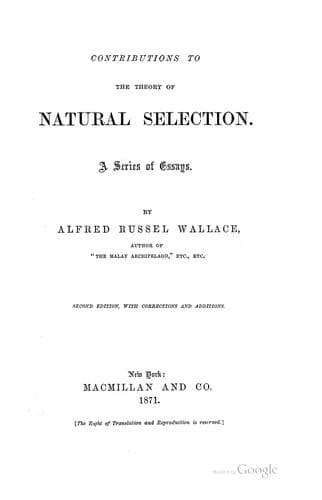
Contributions to the Theory of Natural Selection: A Series of EssaysWallace, Alfred Russel
Science
Contributions to the Theory of Natural Selection: A Series of Essays
Wallace, Alfred Russel
Natural selection
If the views here advocated are correct, as to the various influences
that have determined the specialities of every bird's nest, and the
general colouration of female birds, with their action and reaction on
each other, we can hardly expect to find evidence more complete than
that here set forth. Nature is such a tangled web of complex relations,
that a series of correspondences running through hundreds of species,
genera, and families, in every part of the system, can hardly fail to
indicate a true casual connexion; and when, of the two factors in the
problem, one can be shown to be dependent on the most deeply seated and
the most stable facts of structure and conditions of life, while the
other is a character universally admitted to be superficial and easily
modified, there can be little doubt as to which is cause and which
effect.
_Various modes of Protection of Animals._
But the explanation of the phenomenon here attempted does not rest alone
on the facts I have been able now to adduce. In the essay on "Mimicry,"
it is shown how important a part the necessity for protection has
played, in determining the external form and colouration, and sometimes
even the internal structure of animals.
As illustrating this latter point, I may refer to the remarkable hooked,
branched, or star-like spiculae in many sponges, which are believed to
have the function chiefly, of rendering them unpalatable to other
creatures. The Holothuridae or sea-cucumbers possess a similar
protection, many of them having anchor-shaped spicules embedded in their
skin, as the Synapta; while others (Cuviera squamata) are covered with a
hard calcareous pavement. Many of these are of a bright red or purple
colour, and are very conspicuous, while the allied Trepang, or
Beche-de-mer (Holothuria edulis), which is not armed with any such
defensive weapons, is of a dull sand-or mud-colour, so as hardly to be
distinguished from the sea bed on which it reposes. Many of the smaller
marine animals are protected by their almost invisible transparency,
while those that are most brightly coloured will be often found to have
a special protection, either in stinging tentacles like Physalia, or in
a hard calcareous crust, as in the star fishes.
_Females of some Groups require and obtain more Protection than the
Males._
Public-domain text, read in full here on John Shaqi.
Reviews
Reviews
No reviews yet
Be the first to share your thoughts on this work.
Elsewhere in the archive
Join the Discussion
Join the discussion
Sign in to leave a comment or review.
Sign InorCreate an account