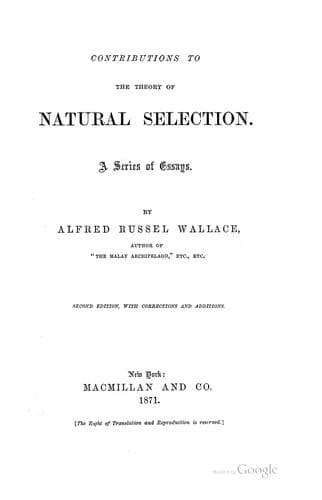
Contributions to the Theory of Natural Selection: A Series of EssaysWallace, Alfred Russel
Science
Contributions to the Theory of Natural Selection: A Series of Essays
Wallace, Alfred Russel
Natural selection
In the struggle for existence incessantly going on, protection or
concealment is one of the most general and most effectual means of
maintaining life; and it is by modifications of colour that this
protection can be most readily obtained, since no other character is
subject to such numerous and rapid variations. The case I have now
endeavoured to illustrate is exactly analogous to what occurs among
butterflies. As a general rule, the female butterfly is of dull and
inconspicuous colours, even when the male is most gorgeously arrayed;
but when the species is protected from attack by a disagreeable odour,
as in the Heliconidae, Danaidae and Acroeidae, both sexes display the same
or equally brilliant hues. Among the species which gain a protection by
imitating these, the very weak and slow-flying Leptalides resemble them
in both sexes, because both sexes alike require protection, while in the
more active and strong-winged genera--Papilio, Pieris, and Diadema--it
is generally the females only that mimic the protected groups, and in
doing so often become actually more gay and more conspicuous than the
males, thus reversing the usual and in fact almost universal characters
of the sexes. So, in the wonderful Eastern leaf-insects of the genus
Phyllium, it is the female only that so marvellously imitates a green
leaf; and in all these cases the difference can be traced to the greater
need of protection for the female, on whose continued existence, while
depositing her eggs, the safety of the race depends. In Mammalia and in
reptiles, however brilliant the colours may be, there is rarely any
difference between that of the sexes, because the female is not
necessarily more exposed to attack than the male. It may, I think, be
looked upon as a confirmation of this view, that no single case is known
either in the above-named genera--Papilio, Pieris, and Diadema--or in
any other butterfly, of a male _alone_, mimicking one of the Danaidae or
Heliconidae. Yet the necessary colour is far more abundant in the males,
and variations always seem ready for any useful purpose. This seems to
depend on the general law, that each species and each sex can only be
modified just as far as is absolutely necessary for it to maintain
itself in the struggle for existence, not a step further. A male insect
by its structure and habits is less exposed to danger, and also requires
less protection than the female. It cannot, therefore, alone acquire any
further protection through the agency of natural selection. But the
female requires some extra protection, to balance the greater danger to
which she is exposed, and her greater importance to the existence of the
species; and this she always acquires, in one way or another, through
the action of natural selection.
Public-domain text, read in full here on John Shaqi.
Reviews
Reviews
No reviews yet
Be the first to share your thoughts on this work.
Elsewhere in the archive
Join the Discussion
Join the discussion
Sign in to leave a comment or review.
Sign InorCreate an account