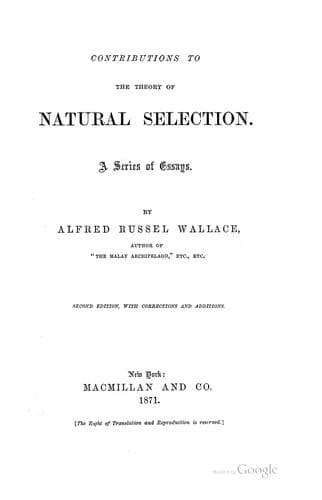
Contributions to the Theory of Natural Selection: A Series of EssaysWallace, Alfred Russel
Science
Contributions to the Theory of Natural Selection: A Series of Essays
Wallace, Alfred Russel
Natural selection
The point on which the Duke of Argyll lays most stress, is, that proofs
of Mind everywhere meet us in Nature, and are more especially manifest
wherever we find "contrivance" or "beauty." He maintains that this
indicates the constant supervision and direct interference of the
Creator, and cannot possibly be explained by the unassisted action of
any combination of laws. Now, Mr. Darwin's work has for its main object,
to show, that all the phenomena of living things,--all their wonderful
organs and complicated structures, their infinite variety of form, size,
and colour, their intricate and involved relations to each other,--may
have been produced by the action of a few general laws of the simplest
kind, laws which are in most cases mere statements of admitted facts.
The chief of these laws or facts are the following:--
1. _The Law of Multiplication in Geometrical Progression._--All
organized beings have enormous powers of multiplication. Even man, who
increases slower than all other animals, could under the most favourable
circumstances double his numbers every fifteen years, or a hundred-fold
in a century. Many animals and plants could increase their numbers from
ten to a thousand-fold every year.
2. _The Law of Limited Populations._--The number of living individuals
of each species in any country, or in the whole globe, is practically
stationary; whence it follows that the whole of this enormous increase
must die off almost as fast as produced, except only those individuals
for whom room is made by the death of parents. As a simple but striking
example, take an oak forest. Every oak will drop annually thousands or
millions of acorns, but till an old tree falls, not one of these
millions can grow up into an oak. They must die at various stages of
growth.
3. _The Law of Heredity, or Likeness of Offspring to their
Parents._--This is a universal, but not an absolute law. All creatures
resemble their parents in a high degree, and in the majority of cases
very accurately; so that even individual peculiarities, of whatever
kind, in the parents, are almost always transmitted to some of the
offspring.
4. _The Law of Variation._--This is fully expressed by the lines:--
"No being on this earthly ball,
Is like another, all in all."
Offspring resemble their parents very much, but not wholly--each being
possesses its individuality. This "variation" itself varies in amount,
but it is always present, not only in the whole being, but in every part
of every being. Every organ, every character, every feeling is
individual; that is to say, _varies_ from the same organ, character, or
feeling in every other individual.
5. _The Law of unceasing Change of Physical Conditions upon the Surface
of the Earth._--Geology shows us that this change has always gone on in
times past, and we also know that it is now everywhere going on.
Public-domain text, read in full here on John Shaqi.
Reviews
Reviews
No reviews yet
Be the first to share your thoughts on this work.
Elsewhere in the archive
Join the Discussion
Join the discussion
Sign in to leave a comment or review.
Sign InorCreate an account