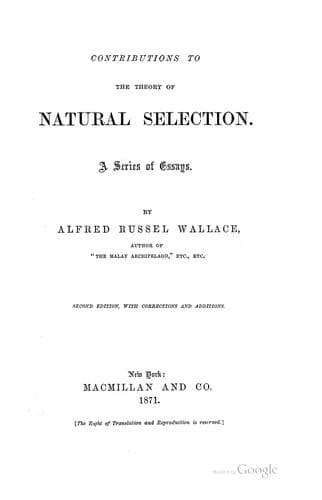
Contributions to the Theory of Natural Selection: A Series of EssaysWallace, Alfred Russel
Science
Contributions to the Theory of Natural Selection: A Series of Essays
Wallace, Alfred Russel
Natural selection
6. _The Equilibrium or Harmony of Nature._--When a species is well
adapted to the conditions which environ it, it flourishes; when
imperfectly adapted it decays; when ill-adapted it becomes extinct. If
_all_ the conditions which determine an organism's well-being are taken
into consideration, this statement can hardly be disputed.
* * * * *
This series of facts or laws, are mere statements of what is the
condition of nature. They are facts or inferences which are generally
known, generally admitted--but in discussing the subject of the "Origin
of Species"--as generally forgotten. It is from these universally
admitted facts, that the origin of all the varied forms of nature may be
deduced by a logical chain of reasoning, which, however, is at every
step verified and shown to be in strict accord with facts; and, at the
same time, many curious phenomena which can by no other means be
understood, are explained and accounted for. It is probable, that these
primary facts or laws are but results of the very nature of life, and of
the essential properties of organized and unorganized matter. Mr.
Herbert Spencer, in his "First Principles" and his "Biology" has, I
think, made us able to understand how this may be; but at present we may
accept these simple laws without going further back, and the question
then is--whether the variety, the harmony, the contrivance, and the
beauty we perceive in organic beings, can have been produced by the
action of these laws alone, or whether we are required to believe in the
incessant interference and direct action of the mind and will of the
Creator. It is simply a question of how the Creator has worked. The
Duke (and I quote him as having well expressed the views of the more
intelligent of Mr. Darwin's opponents) maintains, that He has personally
applied general laws to produce effects, which those laws are not in
themselves capable of producing; that the universe alone, with all its
laws intact, would be a sort of chaos, without variety, without harmony,
without design, without beauty; that there is not (and therefore we may
presume that there could not be) any self-developing power in the
universe. I believe, on the contrary, that the universe is so
constituted as to be self-regulating; that as long as it contains Life,
the forms under which that life is manifested have an inherent power of
adjustment to each other and to surrounding nature; and that this
adjustment necessarily leads to the greatest amount of variety and
beauty and enjoyment, because it does depend on general laws, and not on
a continual supervision and re-arrangement of details. As a matter of
feeling and religion, I hold this to be a far higher conception of the
Creator and of the Universe than that which may be called the "continual
interference" hypothesis; but it is not a question to be decided by our
feelings or convictions, it is a question of facts and of reason. Could
Public-domain text, read in full here on John Shaqi.
Reviews
Reviews
No reviews yet
Be the first to share your thoughts on this work.
Elsewhere in the archive
Join the Discussion
Join the discussion
Sign in to leave a comment or review.
Sign InorCreate an account