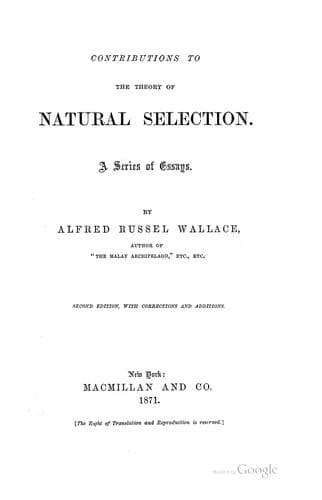
Contributions to the Theory of Natural Selection: A Series of EssaysWallace, Alfred Russel
Science
Contributions to the Theory of Natural Selection: A Series of Essays
Wallace, Alfred Russel
Natural selection
The extraordinary misconception of the whole subject by popular writers
and reviewers, is well shown by an article which appeared in the _Times_
newspaper on "The Reign of Law." Alluding to the supposed economy of
nature, in the adaptation of each species to its own place and its
special use, the reviewer remarks: "To this universal law of the
greatest economy, the law of natural selection stands in direct
antagonism as the law of 'greatest possible waste' of time and of
creative power. To conceive a duck with webbed feet and a spoon-shaped
bill, living by suction, to pass naturally into a gull with webbed feet
and a knife-like bill, living on flesh, in the longest possible time and
in the most laborious possible way, we may conceive it to pass from the
one to the other state by natural selection. The battle of life the
ducks will have to fight will increase in peril continually as they
cease (with the change of their bill) to be ducks, and attain a
_maximum_ of danger in the condition in which they begin to be gulls;
and ages must elapse and whole generations must perish, and countless
generations of the one species be created and sacrificed, to arrive at
one single pair of the other."
In this passage the theory of natural selection is so absurdly
misrepresented that it would be amusing, did we not consider the
misleading effect likely to be produced by this kind of teaching in so
popular a journal. It is assumed that the duck and the gull are
essential parts of nature, each well fitted for its place, and that if
one had been produced from the other by a gradual metamorphosis, the
intermediate forms would have been useless, unmeaning, and unfitted for
any place, in the system of the universe. Now, this idea can only exist
in a mind ignorant of the very foundation and essence of the theory of
natural selection, which is, the preservation of _useful_ variations
only, or, as has been well expressed, in other words, the "survival of
the fittest." Every intermediate form which could possibly have arisen
during the transition from the duck to the gull, so far from having an
unusually severe battle to fight for existence, or incurring any
"_maximum_ of danger," would necessarily have been as accurately
adjusted to the rest of nature, and as well fitted to maintain and to
enjoy its existence, as the duck or the gull actually are. If it were
not so, it never could have been produced under the law of natural
selection.
_Intermediate or generalized Forms of extinct Animals, an indication of
Transmutation or Development._
Public-domain text, read in full here on John Shaqi.
Reviews
Reviews
No reviews yet
Be the first to share your thoughts on this work.
Elsewhere in the archive
Join the Discussion
Join the discussion
Sign in to leave a comment or review.
Sign InorCreate an account