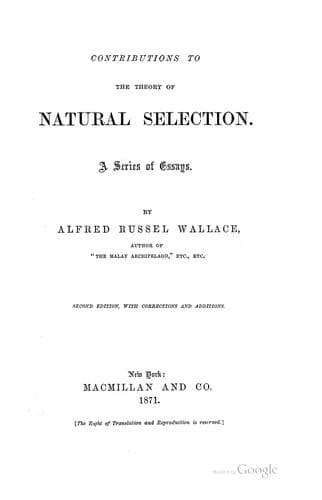
Contributions to the Theory of Natural Selection: A Series of EssaysWallace, Alfred Russel
Science
Contributions to the Theory of Natural Selection: A Series of Essays
Wallace, Alfred Russel
Natural selection
The misconception of this writer illustrates another point very
frequently overlooked. It is an essential part of Mr. Darwin's theory,
that one existing animal has not been derived from any other existing
animal, but that both are the descendants of a common ancestor, which
was at once different from either, but, in essential characters,
intermediate between them both. The illustration of the duck and the
gull is therefore misleading; one of these birds has not been derived
from the other, but both from a common ancestor. This is not a mere
supposition invented to support the theory of natural selection, but is
founded on a variety of indisputable facts. As we go back into past
time, and meet with the fossil remains of more and more ancient races of
extinct animals, we find that many of them actually are intermediate
between distinct groups of existing animals. Professor Owen continually
dwells on this fact: he says in his "Palaeontology," p. 284: "A more
generalized vertebrate structure is illustrated, in the extinct
reptiles, by the affinities to ganoid fishes, shown by Ganocephala,
Labyrinthodontia, and Icthyopterygia; by the affinities of the
Pterosauria to Birds, and by the approximation of the Dinosauria to
Mammals. (These have been recently shown by Professor Huxley to have
more affinity to Birds.) It is manifested by the combination of modern
crocodilian, chelonian, and lacertian characters in the Cryptodontia
and the Dicnyodontia, and by the combined lacertian and crocodilian
characters in the Thecodontia and Sauropterygia." In the same work he
tells us that, "the Anoplotherium, in several important characters
resembled the embryo Ruminant, but retained throughout life those marks
of adhesion to a generalized mammalian type;"--and assures us that he
has "never omitted a proper opportunity for impressing the results of
observations showing the more generalized structures of extinct as
compared with the more specialized forms of recent animals." Modern
palaeontologists have discovered hundreds of examples of these more
generalized or ancestral types. In the time of Cuvier, the Ruminants and
the Pachyderms were looked upon as two of the most distinct orders of
animals; but it is now demonstrated that there once existed a variety of
genera and species, connecting by almost imperceptible grades such
widely different animals as the pig and the camel. Among living
quadrupeds we can scarcely find a more isolated group than the genus
Equus, comprising the horses, asses, and Zebras; but through many
species of Paloplotherium, Hippotherium, and Hipparion, and numbers of
extinct forms of Equus found in Europe, India, and America, an almost
complete transition is established with the Eocene Anoplothorium and
Paleotherium, which are also generalized or ancestral types of the Tapir
and Rhinoceros. The recent researches of M. Gaudry in Greece have
furnished much new evidence of the same character. In the Miocene beds
Public-domain text, read in full here on John Shaqi.
Reviews
Reviews
No reviews yet
Be the first to share your thoughts on this work.
Elsewhere in the archive
Join the Discussion
Join the discussion
Sign in to leave a comment or review.
Sign InorCreate an account