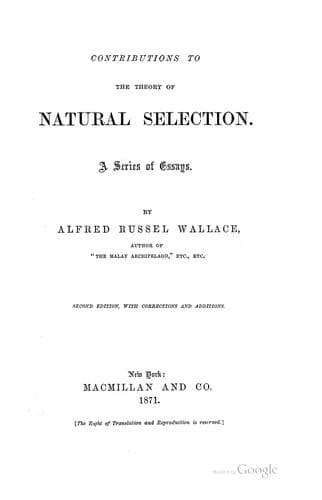
Contributions to the Theory of Natural Selection: A Series of EssaysWallace, Alfred Russel
Science
Contributions to the Theory of Natural Selection: A Series of Essays
Wallace, Alfred Russel
Natural selection
Among the most advanced students of man, there exists a wide difference
of opinion on some of the most vital questions respecting his nature and
origin. Anthropologists are now, indeed, pretty well agreed that man is
not a recent introduction into the earth. All who have studied the
question, now admit that his antiquity is very great; and that, though
we have to some extent ascertained the minimum of time during which he
_must_ have existed, we have made no approximation towards determining
that far greater period during which he _may_ have, and probably _has_
existed. We can with tolerable certainty affirm that man must have
inhabited the earth a thousand centuries ago, but we cannot assert that
he positively did not exist, or that there is any good evidence against
his having existed, for a period of ten thousand centuries. We know
positively, that he was contemporaneous with many now extinct animals,
and has survived changes of the earth's surface fifty or a hundred times
greater than any that have occurred during the historical period; but we
cannot place any definite limit to the number of species he may have
outlived, or to the amount of terrestrial change he may have witnessed.
_Wide differences of opinion as to Man's Origin._
But while on this question of man's antiquity there is a very general
agreement,--and all are waiting eagerly for fresh evidence to clear up
those points which all admit to be full of doubt,--on other, and not
less obscure and difficult questions, a considerable amount of dogmatism
is exhibited; doctrines are put forward as established truths, no doubt
or hesitation is admitted, and it seems to be supposed that no further
evidence is required, or that any new facts can modify our convictions.
This is especially the case when we inquire,--Are the various forms
under which man now exists primitive, or derived from pre-existing
forms; in other words, is man of one or many species? To this question
we immediately obtain distinct answers diametrically opposed to each
other: the one party positively maintaining, that man is a _species_ and
is essentially _one_--that all differences are but local and temporary
variations, produced by the different physical and moral conditions by
which he is surrounded; the other party maintaining with equal
confidence, that man is a genus of _many species_, each of which is
practically unchangeable, and has ever been as distinct, or even more
distinct, than we now behold them. This difference of opinion is
somewhat remarkable, when we consider that both parties are well
acquainted with the subject; both use the same vast accumulation of
facts; both reject those early traditions of mankind which profess to
give an account of his origin; and both declare that they are seeking
fearlessly after truth alone; yet each will persist in looking only at
the portion of truth on his own side of the question, and at the error
which is mingled with his opponent's doctrine.
Public-domain text, read in full here on John Shaqi.
Reviews
Reviews
No reviews yet
Be the first to share your thoughts on this work.
Elsewhere in the archive
Join the Discussion
Join the discussion
Sign in to leave a comment or review.
Sign InorCreate an account