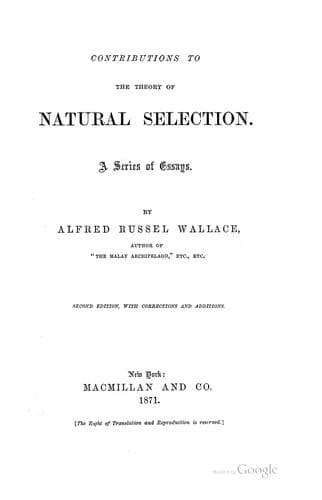
Contributions to the Theory of Natural Selection: A Series of EssaysWallace, Alfred Russel
Science
Contributions to the Theory of Natural Selection: A Series of Essays
Wallace, Alfred Russel
Natural selection
It is my wish to show how
the two opposing views can be combined, so as to eliminate the error and
retain the truth in each, and it is by means of Mr. Darwin's celebrated
theory of "Natural Selection" that I hope to do this, and thus to
harmonise the conflicting theories of modern anthropologists.
Let us first see what each party has to say for itself. In favour of the
unity of mankind it is argued, that there are no races without
transitions to others; that every race exhibits within itself variations
of colour, of hair, of feature, and of form, to such a degree as to
bridge over, to a large extent, the gap that separates it from other
races. It is asserted that no race is homogeneous; that there is a
tendency to vary; that climate, food, and habits produce, and render
permanent, physical peculiarities, which, though slight in the limited
periods allowed to our observation, would, in the long ages during which
the human race has existed, have sufficed to produce all the differences
that now appear. It is further asserted that the advocates of the
opposite theory do not agree among themselves; that some would make
three, some five, some fifty or a hundred and fifty species of man; some
would have had each species created in pairs, while others require
nations to have at once sprung into existence, and that there is no
stability or consistency in any doctrine but that of one primitive
stock.
The advocates of the original diversity of man, on the other hand, have
much to say for themselves. They argue that proofs of change in man have
never been brought forward except to the most trifling amount, while
evidence of his permanence meets us everywhere. The Portuguese and
Spaniards, settled for two or three centuries in South America, retain
their chief physical, mental, and moral characteristics; the Dutch boers
at the Cape, and the descendants of the early Dutch settlers in the
Moluccas, have not lost the features or the colour of the Germanic
races; the Jews, scattered over the world in the most diverse climates,
retain the same characteristic lineaments everywhere; the Egyptian
sculptures and paintings show us that, for at least 4000 or 5000 years,
the strongly contrasted features of the Negro and the Semitic races have
remained altogether unchanged; while more recent discoveries prove, that
the mound-builders of the Mississippi valley, and the dwellers on
Brazilian mountains, had, even in the very infancy of the human race,
some traces of the same peculiar and characteristic type of cranial
formation that now distinguishes them.
Public-domain text, read in full here on John Shaqi.
Reviews
Reviews
No reviews yet
Be the first to share your thoughts on this work.
Elsewhere in the archive
Join the Discussion
Join the discussion
Sign in to leave a comment or review.
Sign InorCreate an account