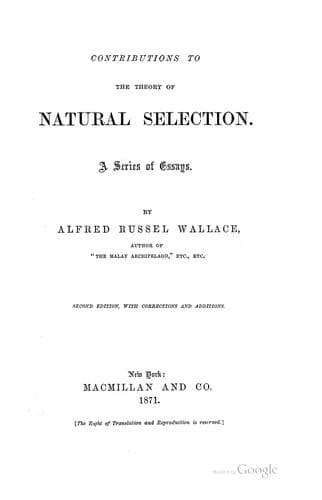
Contributions to the Theory of Natural Selection: A Series of EssaysWallace, Alfred Russel
Science
Contributions to the Theory of Natural Selection: A Series of Essays
Wallace, Alfred Russel
Natural selection
Mr.
Darwin calls this "correlation of growth," and gives as instances, that
hairless dogs have imperfect teeth; white cats, when blue-eyed, are
deaf; small feet accompany short beaks in pigeons; and other equally
interesting cases.
Grant, therefore, the premises: 1st. That peculiarities of every kind
are more or less hereditary. 2nd. That the offspring of every animal
vary more or less in all parts of their organization. 3rd. That
the universe in which these animals live, is not absolutely
invariable;--none of which propositions can be denied; and then
consider, that the animals in any country (those at least which are not
dying out) must at each successive period be brought into harmony with
the surrounding conditions; and we have all the elements for a change of
form and structure in the animals, keeping exact pace with changes of
whatever nature in the surrounding universe. Such changes must be slow,
for the changes in the universe are very slow; but just as these slow
changes become important, when we look at results after long periods of
action, as we do when we perceive the alterations of the earth's surface
during geological epochs; so the parallel changes in animal form become
more and more striking, in proportion as the time they have been going
on is great; as we see when we compare our living animals with those
which we disentomb from each successively older geological formation.
This is, briefly, the theory of "natural selection," which explains the
changes in the organic world as being parallel with, and in part
dependent on, those in the inorganic. What we now have to inquire
is,--Can this theory be applied in any way to the question of the origin
of the races of man? or is there anything in human nature that takes him
out of the category of those organic existences, over whose successive
mutations it has had such powerful sway?
_Different effects of Natural Selection on Animals and on Man._
In order to answer these questions, we must consider why it is that
"natural selection" acts so powerfully upon animals; and we shall, I
believe, find, that its effect depends mainly upon their self-dependence
and individual isolation. A slight injury, a temporary illness, will
often end in death, because it leaves the individual powerless against
its enemies. If an herbivorous animal is a little sick and has not fed
well for a day or two, and the herd is then pursued by a beast of prey,
our poor invalid inevitably falls a victim. So, in a carnivorous animal,
the least deficiency of vigour prevents its capturing food, and it soon
dies of starvation. There is, as a general rule, no mutual assistance
between adults, which enables them to tide over a period of sickness.
Neither is there any division of labour; each must fulfil _all_ the
conditions of its existence, and, therefore, "natural selection" keeps
all up to a pretty uniform standard.
Public-domain text, read in full here on John Shaqi.
Reviews
Reviews
No reviews yet
Be the first to share your thoughts on this work.
Elsewhere in the archive
Join the Discussion
Join the discussion
Sign in to leave a comment or review.
Sign InorCreate an account