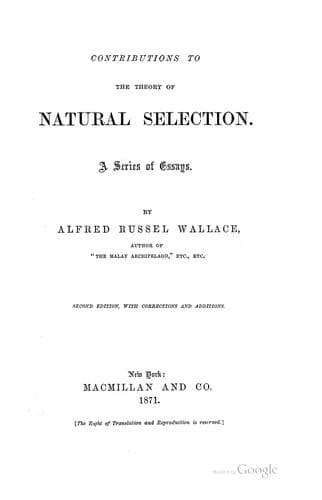
Contributions to the Theory of Natural Selection: A Series of EssaysWallace, Alfred Russel
Science
Contributions to the Theory of Natural Selection: A Series of Essays
Wallace, Alfred Russel
Natural selection
Now, health, strength, and long life, are the results of a harmony
between the individual and the universe that surrounds it. Let us
suppose that at any given moment this harmony is perfect. A certain
animal is exactly fitted to secure its prey, to escape from its enemies,
to resist the inclemencies of the seasons, and to rear a numerous and
healthy offspring. But a change now takes place. A series of cold
winters, for instance, come on, making food scarce, and bringing an
immigration of some other animals to compete with the former inhabitants
of the district. The new immigrant is swift of foot, and surpasses its
rivals in the pursuit of game; the winter nights are colder, and require
a thicker fur as a protection, and more nourishing food to keep up the
heat of the system. Our supposed perfect animal is no longer in harmony
with its universe; it is in danger of dying of cold or of starvation.
But the animal varies in its offspring. Some of these are swifter than
others--they still manage to catch food enough; some are hardier and
more thickly furred--they manage in the cold nights to keep warm enough;
the slow, the weak, and the thinly clad soon die off. Again and again,
in each succeeding generation, the same thing takes place. By this
natural process, which is so inevitable that it cannot be conceived not
to act, those best adapted to live, live; those least adapted, die. It
is sometimes said that we have no direct evidence of the action of this
selecting power in nature. But it seems to me we have better evidence
than even direct observation would be, because it is more universal,
viz., the evidence of necessity. It must be so; for, as all wild animals
increase in a geometrical ratio, while their actual numbers remain on
the average stationary, it follows, that as many die annually as are
born. If, therefore, we deny natural selection, it can only be by
asserting that, in such a case as I have supposed, the strong, the
healthy, the swift, the well clad, the well organised animals in every
respect, have no advantage over,--do not on the average live longer
than, the weak, the unhealthy, the slow, the ill-clad, and the
imperfectly organised individuals; and this no sane man has yet been
found hardy enough to assert. But this is not all; for the offspring on
the average resemble their parents, and the selected portion of each
succeeding generation will therefore be stronger, swifter, and more
thickly furred than the last; and if this process goes on for thousands
of generations, our animal will have again become thoroughly in harmony
with the new conditions in which it is placed. But it will now be a
different creature. It will be not only swifter and stronger, and more
furry, it will also probably have changed in colour, in form, perhaps
have acquired a longer tail, or differently shaped ears; for it is an
ascertained fact, that when one part of an animal is modified, some
other parts almost always change, as it were in sympathy with it.
Public-domain text, read in full here on John Shaqi.
Reviews
Reviews
No reviews yet
Be the first to share your thoughts on this work.
Elsewhere in the archive
Join the Discussion
Join the discussion
Sign in to leave a comment or review.
Sign InorCreate an account