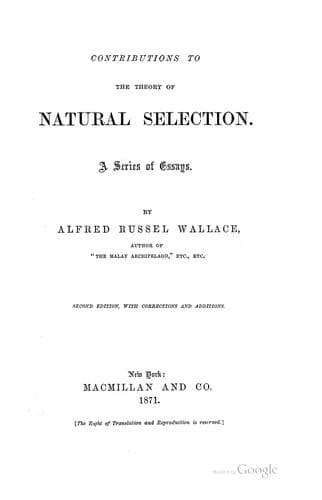
Contributions to the Theory of Natural Selection: A Series of EssaysWallace, Alfred Russel
Science
Contributions to the Theory of Natural Selection: A Series of Essays
Wallace, Alfred Russel
Natural selection
I would also venture to suggest some reasons against the very nature of
the theory of Professor Forbes. Our knowledge of the organic world
during any geological epoch is necessarily very imperfect. Looking at
the vast numbers of species and groups that have been discovered by
geologists, this may be doubted; but we should compare their numbers not
merely with those that now exist upon the earth, but with a far larger
amount. We have no reason for believing that the number of species on
the earth at any former period was much less than at present; at all
events the aquatic portion, with which geologists have most
acquaintance, was probably often as great or greater. Now we know that
there have been many complete changes of species; new sets of organisms
have many times been introduced in place of old ones which have become
extinct, so that the total amount which have existed on the earth from
the earliest geological period must have borne about the same proportion
to those now living, as the whole human race who have lived and died
upon the earth, to the population at the present time. Again, at each
epoch, the whole earth was no doubt, as now, more or less the theatre of
life, and as the successive generations of each species died, their
exuviae and preservable parts would be deposited over every portion of
the then existing seas and oceans, which we have reason for supposing to
have been more, rather than less, extensive than at present. In order
then to understand our possible knowledge of the early world and its
inhabitants, we must compare, not the area of the whole field of our
geological researches with the earth's surface, but the area of the
examined portion of each formation separately with the whole earth. For
example, during the Silurian period all the earth was Silurian, and
animals were living and dying, and depositing their remains more or less
over the whole area of the globe, and they were probably (the species at
least) nearly as varied in different latitudes and longitudes as at
present. What proportion do the Silurian districts bear to the whole
surface of the globe, land and sea (for far more extensive Silurian
districts probably exist beneath the ocean than above it), and what
portion of the known Silurian districts has been actually examined for
fossils? Would the area of rock actually laid open to the eye be the
thousandth or the ten-thousandth part of the earth's surface? Ask the
same question with regard to the Oolite or the Chalk, or even to
particular beds of these when they differ considerably in their
fossils, and you may then get some notion of how small a portion of the
whole we know.
Public-domain text, read in full here on John Shaqi.
Reviews
Reviews
No reviews yet
Be the first to share your thoughts on this work.
Join the Discussion
Join the discussion
Sign in to leave a comment or review.
Sign InorCreate an account