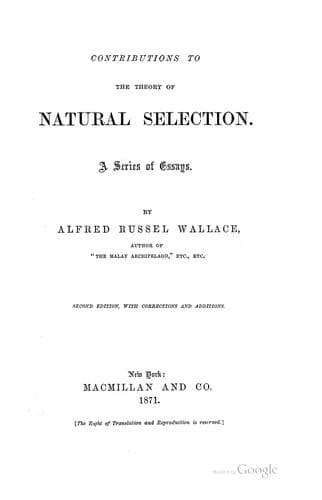
Contributions to the Theory of Natural Selection: A Series of EssaysWallace, Alfred Russel
Science
Contributions to the Theory of Natural Selection: A Series of Essays
Wallace, Alfred Russel
Natural selection
If these views are correct; if in proportion as man's social, moral, and
intellectual faculties became developed, his physical structure would
cease to be affected by the operation of "natural selection," we have a
most important clue to the origin of races. For it will follow, that
those great modifications of structure and of external form, which
resulted in the development of man out of some lower type of animal,
must have occurred before his intellect had raised him above the
condition of the brutes, at a period when he was gregarious, but
scarcely social, with a mind perceptive but not reflective, ere any
sense of _right_ or feelings of _sympathy_ had been developed in him. He
would be still subject, like the rest of the organic world, to the
action of "natural selection," which would retain his physical form and
constitution in harmony with the surrounding universe. He was probably
at a very early period a dominant race, spreading widely over the warmer
regions of the earth as it then existed, and in agreement with what we
see in the case of other dominant species, gradually becoming modified
in accordance with local conditions. As he ranged farther from his
original home, and became exposed to greater extremes of climate, to
greater changes of food, and had to contend with new enemies, organic
and inorganic, slight useful variations in his constitution would be
selected and rendered permanent, and would, on the principle of
"correlation of growth," be accompanied by corresponding external
physical changes. Thus might have arisen those striking characteristics
and special modifications which still distinguish the chief races of
mankind. The red, black, yellow, or blushing white skin; the straight,
the curly, the woolly hair; the scanty or abundant beard; the straight
or oblique eyes; the various forms of the pelvis, the cranium, and other
parts of the skeleton.
But while these changes had been going on, his mental development had,
from some unknown cause, greatly advanced, and had now reached that
condition in which it began powerfully to influence his whole existence,
and would therefore become subject to the irresistible action of
"natural selection." This action would quickly give the ascendency to
mind: speech would probably now be first developed, leading to a still
further advance of the mental faculties; and from that moment man, as
regards the form and structure of most parts of his body, would remain
almost stationary. The art of making weapons, division of labour,
anticipation of the future, restraint of the appetites, moral, social,
and sympathetic feelings, would now have a preponderating influence on
his well being, and would therefore be that part of his nature on which
"natural selection" would most powerfully act; and we should thus have
explained that wonderful persistence of mere physical characteristics,
which is the stumbling-block of those who advocate the unity of mankind.
Public-domain text, read in full here on John Shaqi.
Reviews
Reviews
No reviews yet
Be the first to share your thoughts on this work.
Elsewhere in the archive
Join the Discussion
Join the discussion
Sign in to leave a comment or review.
Sign InorCreate an account