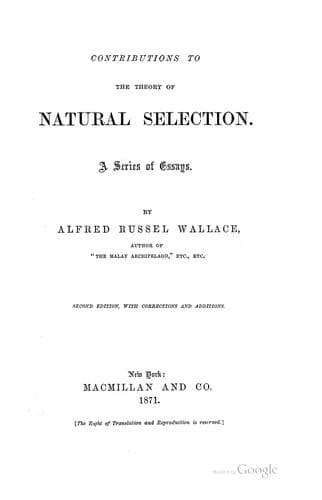
Contributions to the Theory of Natural Selection: A Series of EssaysWallace, Alfred Russel
Science
Contributions to the Theory of Natural Selection: A Series of Essays
Wallace, Alfred Russel
Natural selection
We are now, therefore, enabled to harmonise the conflicting views of
anthropologists on this subject. Man may have been, indeed I believe
must have been, once a homogeneous race; but it was at a period of which
we have as yet discovered no remains, at a period so remote in his
history, that he had not yet acquired that wonderfully developed brain,
the organ of the mind, which now, even in his lowest examples, raises
him far above the highest brutes;--at a period when he had the form but
hardly the nature of man, when he neither possessed human speech, nor
those sympathetic and moral feelings which in a greater or less degree
everywhere now distinguish the race. Just in proportion as these truly
human faculties became developed in him, would his physical features
become fixed and permanent, because the latter would be of less
importance to his well being; he would be kept in harmony with the
slowly changing universe around him, by an advance in mind, rather than
by a change in body. If, therefore, we are of opinion that he was not
really man till these higher faculties were fully developed, we may
fairly assert that there were many originally distinct races of men;
while, if we think that a being closely resembling us in form and
structure, but with mental faculties scarcely raised above the brute,
must still be considered to have been human, we are fully entitled to
maintain the common origin of all mankind.
_The Bearing of these Views on the Antiquity of Man._
These considerations, it will be seen, enable us to place the origin of
man at a much more remote geological epoch than has yet been thought
possible. He may even have lived in the Miocene or Eocene period, when
not a single mammal was identical in form with any existing species.
For, in the long series of ages during which these primeval animals were
being slowly changed into the species which now inhabit the earth, the
power which acted to modify them would only affect the mental
organization of man. His brain alone would have increased in size and
complexity, and his cranium have undergone corresponding changes of
form, while the whole structure of lower animals was being changed. This
will enable us to understand how the fossil crania of Denise and Engis
agree so closely with existing forms, although they undoubtedly existed
in company with large mammalia now extinct. The Neanderthal skull may be
a specimen of one of the lowest races then existing, just as the
Australians are the lowest of our modern epoch. We have no reason to
suppose that mind and brain and skull modification, could go on quicker
than that of the other parts of the organization; and we must therefore
look back very far in the past, to find man in that early condition in
which his mind was not sufficiently developed, to remove his body from
the modifying influence of external conditions and the cumulative action
of "natural selection." I believe, therefore, that there is no _a
Public-domain text, read in full here on John Shaqi.
Reviews
Reviews
No reviews yet
Be the first to share your thoughts on this work.
Elsewhere in the archive
Join the Discussion
Join the discussion
Sign in to leave a comment or review.
Sign InorCreate an account