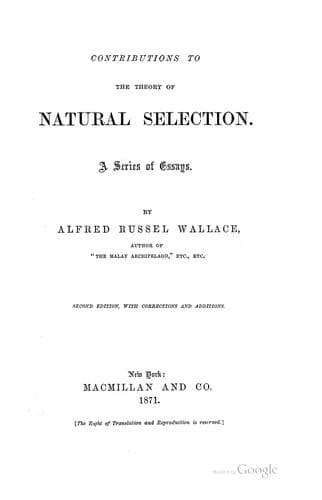
Contributions to the Theory of Natural Selection: A Series of EssaysWallace, Alfred Russel
Science
Contributions to the Theory of Natural Selection: A Series of Essays
Wallace, Alfred Russel
Natural selection
priori_ reason against our finding the remains of man or his works in
the tertiary deposits. The absence of all such remains in the European
beds of this age has little weight, because, as we go further back in
time, it is natural to suppose that man's distribution over the surface
of the earth was less universal than at present.
Besides, Europe was in a great measure submerged during the tertiary
epoch; and though its scattered islands may have been uninhabited by
man, it by no means follows that he did not at the same time exist in
warm or tropical continents. If geologists can point out to us the most
extensive land in the warmer regions of the earth, which has not been
submerged since Eocene or Miocene times, it is there that we may expect
to find some traces of the very early progenitors of man. It is there
that we may trace back the gradually decreasing brain of former races,
till we come to a time when the body also begins materially to differ.
Then we shall have reached the starting point of the human family.
Before that period, he had not mind enough to preserve his body from
change, and would, therefore, have been subject to the same
comparatively rapid modifications of form as the other mammalia.
_Their Bearing on the Dignity and Supremacy of Man._
If the views I have here endeavoured to sustain have any foundation,
they give us a new argument for placing man apart, as not only the head
and culminating point of the grand series of organic nature, but as in
some degree a new and distinct order of being. From those infinitely
remote ages, when the first rudiments of organic life appeared upon the
earth, every plant, and every animal has been subject to one great law
of physical change. As the earth has gone through its grand cycles of
geological, climatal, and organic progress, every form of life has been
subject to its irresistible action, and has been continually, but
imperceptibly moulded into such new shapes as would preserve their
harmony with the ever-changing universe. No living thing could escape
this law of its being; none (except, perhaps, the simplest and most
rudimentary organisms), could remain unchanged and live, amid the
universal change around it.
Public-domain text, read in full here on John Shaqi.
Reviews
Reviews
No reviews yet
Be the first to share your thoughts on this work.
Elsewhere in the archive
Join the Discussion
Join the discussion
Sign in to leave a comment or review.
Sign InorCreate an account