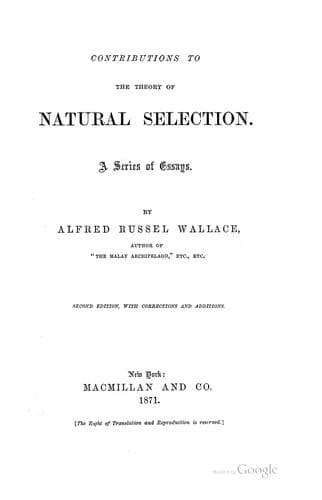
Contributions to the Theory of Natural Selection: A Series of EssaysWallace, Alfred Russel
Science
Contributions to the Theory of Natural Selection: A Series of Essays
Wallace, Alfred Russel
Natural selection
action of natural laws in the development of organic forms, and can
clearly conceive that fuller knowledge would enable us to follow step by
step the whole process of that development, so surely can we trace the
action of some unknown higher law, beyond and independent of all those
laws of which we have any knowledge. We can trace this action more or
less distinctly in many phenomena, the two most important of which
are--the origin of sensation or consciousness, and the development of
man from the lower animals. I shall first consider the latter difficulty
as more immediately connected with the subjects discussed in this
volume.
_What Natural Selection can Not do._
In considering the question of the development of man by known natural
laws, we must ever bear in mind the first principle of "natural
selection," no less than of the general theory of evolution, that all
changes of form or structure, all increase in the size of an organ or in
its complexity, all greater specialization or physiological division of
labour, can only be brought about, in as much as it is for the good of
the being so modified. Mr. Darwin himself has taken care to impress
upon us, that "natural selection" has no power to produce absolute
perfection but only relative perfection, no power to advance any being
much beyond his follow beings, but only just so much beyond them as to
enable it to survive them in the struggle for existence. Still less has
it any power to produce modifications which are in any degree injurious
to its possessor, and Mr. Darwin frequently uses the strong expression,
that a single case of this kind would be fatal to his theory. If,
therefore, we find in man any characters, which all the evidence we can
obtain goes to show would have been actually injurious to him on their
first appearance, they could not possibly have been produced by natural
selection. Neither could any specially developed organ have been so
produced if it had been merely useless to him, or if its use were not
proportionate to its degree of development. Such cases as these would
prove, that some other law, or some other power, than "natural
selection" had been at work. But if, further, we could see that these
very modifications, though hurtful or useless at the time when they
first appeared, became in the highest degree useful at a much later
period, and are now essential to the full moral and intellectual
development of human nature, we should then infer the action of mind,
foreseeing the future and preparing for it, just as surely as we do,
when we see the breeder set himself to work with the determination to
produce a definite improvement in some cultivated plant or domestic
animal. I would further remark that this enquiry is as thoroughly
scientific and legitimate as that into the origin of species itself. It
is an attempt to solve the inverse problem, to deduce the existence of a
new power of a definite character, in order to account for facts which
Public-domain text, read in full here on John Shaqi.
Reviews
Reviews
No reviews yet
Be the first to share your thoughts on this work.
Elsewhere in the archive
Join the Discussion
Join the discussion
Sign in to leave a comment or review.
Sign InorCreate an account