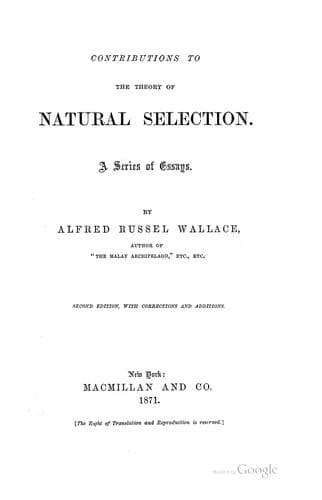
Contributions to the Theory of Natural Selection: A Series of EssaysWallace, Alfred Russel
Science
Contributions to the Theory of Natural Selection: A Series of Essays
Wallace, Alfred Russel
Natural selection
according to the theory of natural selection ought not to happen. Such
problems are well known to science, and the search after their solution
has often led to the most brilliant results. In the case of man, there
are facts of the nature above alluded to, and in calling attention to
them, and in inferring a cause for them, I believe that I am as strictly
within the bounds of scientific investigation as I have been in any
other portion of my work.
_The Brain of the Savage shown to be Larger than he Needs it to be._
_Size of Brain an important Element of Mental Power._--The brain is
universally admitted to be the organ of the mind; and it is almost as
universally admitted, that size of brain is one of the most important of
the elements which determine mental power or capacity. There seems to be
no doubt that brains differ considerably in quality, as indicated by
greater or less complexity of the convolutions, quantity of grey matter,
and perhaps unknown peculiarities of organization; but this difference
of quality seems merely to increase or diminish the influence of
quantity, not to neutralize it. Thus, all the most eminent modern
writers see an intimate connection between the diminished size of the
brain in the lower races of mankind, and their intellectual
inferiority. The collections of Dr. J. B. Davis and Dr. Morton give the
following as the average internal capacity of the cranium in the chief
races:--Teutonic family, 94 cubic inches; Esquimaux, 91 cubic inches;
Negroes, 85 cubic inches; Australians and Tasmanians, 82 cubic inches;
Bushmen, 77 cubic inches. These last numbers, however, are deduced from
comparatively few specimens, and may be below the average, just as a
small number of Finns and Cossacks give 98 cubic inches, or considerably
more than that of the German races. It is evident, therefore, that the
absolute bulk of the brain is not necessarily much less in savage than
in civilised man, for Esquimaux skulls are known with a capacity of 113
inches, or hardly less than the largest among Europeans. But what is
still more extraordinary, the few remains yet known of pre-historic man
do not indicate any material diminution in the size of the brain case. A
Swiss skull of the stone age, found in the lake dwelling of Meilen,
corresponded exactly to that of a Swiss youth of the present day. The
celebrated Neanderthal skull had a larger circumference than the
average, and its capacity, indicating actual mass of brain, is estimated
to have been not less than 75 cubic inches, or nearly the average of
existing Australian crania. The Engis skull, perhaps the oldest known,
and which, according to Sir John Lubbock, "there seems no doubt was
really contemporary with the mammoth and the cave bear," is yet,
according to Professor Huxley, "a fair average skull, which might have
belonged to a philosopher, or might have contained the thoughtless
brains of a savage." Of the cave men of Les Eyzies, who were undoubtedly
Public-domain text, read in full here on John Shaqi.
Reviews
Reviews
No reviews yet
Be the first to share your thoughts on this work.
Elsewhere in the archive
Join the Discussion
Join the discussion
Sign in to leave a comment or review.
Sign InorCreate an account