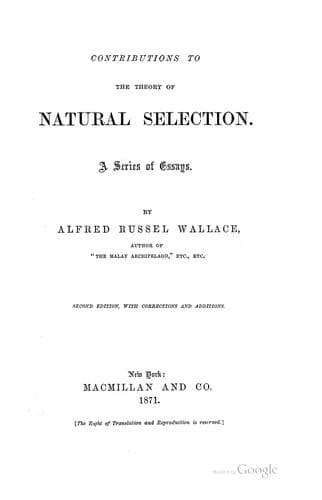
Contributions to the Theory of Natural Selection: A Series of EssaysWallace, Alfred Russel
Science
Contributions to the Theory of Natural Selection: A Series of Essays
Wallace, Alfred Russel
Natural selection
contemporary with the reindeer in the South of France, Professor Paul
Broca says (in a paper read before the Congress of Pre-historic
Archaeology in 1868)--"The great capacity of the brain, the development
of the frontal region, the fine elliptical form of the anterior part of
the profile of the skull, are incontestible characteristics of
superiority, such as we are accustomed to meet with in civilised races;"
yet the great breadth of the face, the enormous development of the
ascending ramus of the lower jaw, the extent and roughness of the
surfaces for the attachment of the muscles, especially of the
masticators, and the extraordinary development of the ridge of the
femur, indicate enormous muscular power, and the habits of a savage and
brutal race.
These facts might almost make us doubt whether the size of the brain is
in any direct way an index of mental power, had we not the most
conclusive evidence that it is so, in the fact that, whenever an adult
male European has a skull less than nineteen inches in circumference, or
has less than sixty-five cubic inches of brain, he is invariably
idiotic. When we join with this the equally undisputed fact, that great
men--those who combine acute perception with great reflective power,
strong passions, and general energy of character, such as Napoleon,
Cuvier, and O'Connell, have always heads far above the average size, we
must feel satisfied that volume of brain is one, and perhaps the most
important, measure of intellect; and this being the case, we cannot fail
to be struck with the apparent anomaly, that many of the lowest savages
should have as much brains as average Europeans. The idea is suggested
of a surplusage of power; of an instrument beyond the needs of its
possessor.
Public-domain text, read in full here on John Shaqi.
Reviews
Reviews
No reviews yet
Be the first to share your thoughts on this work.
Elsewhere in the archive
Join the Discussion
Join the discussion
Sign in to leave a comment or review.
Sign InorCreate an account