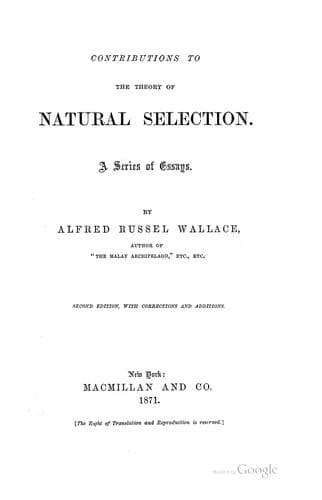
Contributions to the Theory of Natural Selection: A Series of EssaysWallace, Alfred Russel
Science
Contributions to the Theory of Natural Selection: A Series of Essays
Wallace, Alfred Russel
Natural selection
a love of truth as the most moral among civilized men. The Hindoo and
the Polynesian have a high artistic feeling, the first traces of which
are clearly visible in the rude drawings of the palaeolithic men who were
the contemporaries in France of the Reindeer and the Mammoth. Instances
of unselfish love, of true gratitude, and of deep religious feeling,
sometimes occur among most savage races.
On the whole, then, we may conclude, that the general moral and
intellectual development of the savage, is not less removed from that of
civilized man than has been shown to be the case in the one department
of mathematics; and from the fact that all the moral and intellectual
faculties do occasionally manifest themselves, we may fairly conclude
that they are always latent, and that the large brain of the savage man
is much beyond his actual requirements in the savage state.
_Intellect of Savages and of Animals compared._--Let us now compare the
intellectual wants of the savage, and the actual amount of intellect he
exhibits, with those of the higher animals. Such races as the Andaman
Islanders, the Australians, and the Tasmanians, the Digger Indians of
North America, or the natives of Fuegia, pass their lives so as to
require the exercise of few faculties not possessed in an equal degree
by many animals. In the mode of capture of game or fish, they by no
means surpass the ingenuity or forethought of the jaguar, who drops
saliva into the water, and seizes the fish as they come to eat it; or of
wolves and jackals, who hunt in packs; or of the fox, who buries his
surplus food till he requires it. The sentinels placed by antelopes and
by monkeys, and the various modes of building adopted by field mice and
beavers, as well as the sleeping place of the orang-utan, and the
tree-shelter of some of the African anthropoid apes, may well be
compared with the amount of care and forethought bestowed by many
savages in similar circumstances. His possession of free and perfect
hands, not required for locomotion, enable man to form and use weapons
and implements which are beyond the physical powers of brutes; but
having done this, he certainly does not exhibit more mind in using them
than do many lower animals. What is there in the life of the savage, but
the satisfying of the cravings of appetite in the simplest and easiest
way? What thoughts, ideas, or actions are there, that raise him many
grades above the elephant or the ape? Yet he possesses, as we have seen,
a brain vastly superior to theirs in size and complexity; and this brain
gives him, in an undeveloped state, faculties which he never requires to
use. And if this is true of existing savages, how much more true must
it have been of the men whose sole weapons were rudely chipped flints,
and some of whom, we may fairly conclude, were lower than any existing
race; while the only evidence yet in our possession shows them to have
had brains fully as capacious as those of the average of the lower
savage races.
Public-domain text, read in full here on John Shaqi.
Reviews
Reviews
No reviews yet
Be the first to share your thoughts on this work.
Elsewhere in the archive
Join the Discussion
Join the discussion
Sign in to leave a comment or review.
Sign InorCreate an account