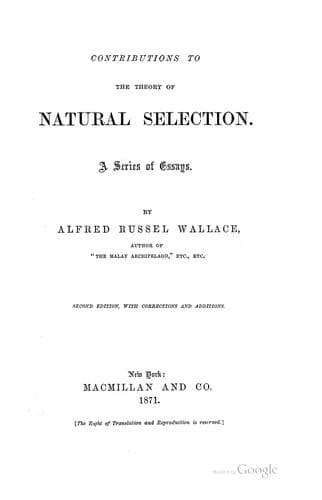
Contributions to the Theory of Natural Selection: A Series of EssaysWallace, Alfred Russel
Science
Contributions to the Theory of Natural Selection: A Series of Essays
Wallace, Alfred Russel
Natural selection
We see, then, that whether we compare the savage with the higher
developments of man, or with the brutes around him, we are alike driven
to the conclusion that in his large and well-developed brain he
possesses an organ quite disproportionate to his actual requirements--an
organ that seems prepared in advance, only to be fully utilized as he
progresses in civilization. A brain slightly larger than that of the
gorilla would, according to the evidence before us, fully have sufficed
for the limited mental development of the savage; and we must therefore
admit, that the large brain he actually possesses could never have been
solely developed by any of those laws of evolution, whose essence is,
that they lead to a degree of organization exactly proportionate to the
wants of each species, never beyond those wants--that no preparation can
be made for the future development of the race--that one part of the
body can never increase in size or complexity, except in strict
co-ordination to the pressing wants of the whole. The brain of
pre-historic and of savage man seems to me to prove the existence of
some power, distinct from that which has guided the development of the
lower animals through their ever-varying forms of being.
_The Use of the Hairy Covering of Mammalia._
Let us now consider another point in man's organization, the bearing of
which has been almost entirely overlooked by writers on both sides of
this question. One of the most general external characters of the
terrestrial mammalia is the hairy covering of the body, which, whenever
the skin is flexible, soft, and sensitive, forms a natural protection
against the severities of climate, and particularly against rain. That
this is its most important function, is well shown by the manner in
which the hairs are disposed so as to carry off the water, by being
invariably directed downwards from the most elevated parts of the body.
Thus, on the under surface the hair is always less plentiful, and, in
many cases, the belly is almost bare. The hair lies downwards, on the
limbs of all walking mammals, from the shoulder to the toes, but in the
orang-utan it is directed from the shoulder to the elbow, and again from
the wrist to the elbow, in a reverse direction. This corresponds to the
habits of the animal, which, when resting, holds its long arms upwards
over its head, or clasping a branch above it, so that the rain would
flow down both the arm and fore-arm to the long hair which meets at the
elbow. In accordance with this principle, the hair is always longer or
more dense along the spine or middle of the back from the nape to the
tail, often rising into a crest of hair or bristles on the ridge of the
back. This character prevails through the entire series of the mammalia,
from the marsupials to the quadrumana, and by this long persistence it
must have acquired such a powerful hereditary tendency, that we should
expect it to reappear continually even after it had been abolished by
Public-domain text, read in full here on John Shaqi.
Reviews
Reviews
No reviews yet
Be the first to share your thoughts on this work.
Elsewhere in the archive
Join the Discussion
Join the discussion
Sign in to leave a comment or review.
Sign InorCreate an account