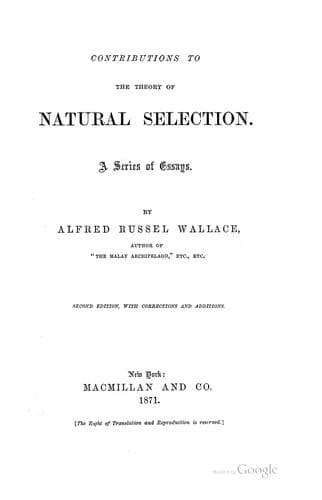
Contributions to the Theory of Natural Selection: A Series of EssaysWallace, Alfred Russel
Science
Contributions to the Theory of Natural Selection: A Series of Essays
Wallace, Alfred Russel
Natural selection
It seems to me, then, to be absolutely certain, that "Natural Selection"
could not have produced man's hairless body by the accumulation of
variations from a hairy ancestor. The evidence all goes to show that
such variations could not have been useful, but must, on the contrary,
have been to some extent hurtful. If even, owing to an unknown
correlation with other hurtful qualities, it had been abolished in the
ancestral tropical man, we cannot conceive that, as man spread into
colder climates, it should not have returned under the powerful
influence of reversion to such a long persistent ancestral type. But the
very foundation of such a supposition as this is untenable; for we
cannot suppose that a character which, like hairiness, exists throughout
the whole of the mammalia, can have become, in one form only, so
constantly correlated with an injurious character, as to lead to its
permanent suppression--a suppression so complete and effectual that it
never, or scarcely ever, reappears in mongrels of the most widely
different races of man.
Two characters could hardly be wider apart, than the size and
development of man's brain, and the distribution of hair upon the
surface of his body; yet they both lead us to the same conclusion--that
some other power than Natural Selection has been engaged in his
production.
_Feet and Hands of Man, considered as Difficulties on the Theory of
Natural Selection._
There are a few other physical characteristics of man, that may just be
mentioned as offering similar difficulties, though I do not attach the
same importance to them as to those I have already dwelt on. The
specialization and perfection of the hands and feet of man seems
difficult to account for. Throughout the whole of the quadrumana the
foot is prehensile; and a very rigid selection must therefore have been
needed to bring about that arrangement of the bones and muscles, which
has converted the thumb into a great toe, so completely, that the power
of opposability is totally lost in every race, whatever some travellers
may vaguely assert to the contrary. It is difficult to see why the
prehensile power should have been taken away. It must certainly have
been useful in climbing, and the case of the baboons shows that it is
quite compatible with terrestrial locomotion. It may not be compatible
with perfectly easy erect locomotion; but, then, how can we conceive
that early man, _as an animal_, gained anything by purely erect
locomotion? Again, the hand of man contains latent capacities and powers
which are unused by savages, and must have been even less used by
palaeolithic man and his still ruder predecessors. It has all the
appearance of an organ prepared for the use of civilized man, and one
which was required to render civilization possible. Apes make little use
of their separate fingers and opposable thumbs. They grasp objects
rudely and clumsily, and look as if a much less specialized extremity
would have served their purpose as well.
Public-domain text, read in full here on John Shaqi.
Reviews
Reviews
No reviews yet
Be the first to share your thoughts on this work.
Elsewhere in the archive
Join the Discussion
Join the discussion
Sign in to leave a comment or review.
Sign InorCreate an account