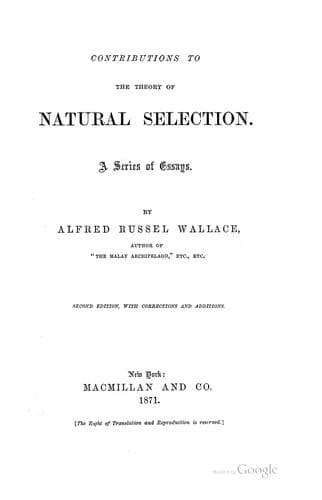
Contributions to the Theory of Natural Selection: A Series of EssaysWallace, Alfred Russel
Science
Contributions to the Theory of Natural Selection: A Series of Essays
Wallace, Alfred Russel
Natural selection
I do not lay much stress on
this, but, if it be proved that some intelligent power has guided or
determined the development of man, then we may see indications of that
power, in facts which, by themselves, would not serve to prove its
existence.
_The voice of man._--The same remark will apply to another peculiarly
human character, the wonderful power, range, flexibility, and sweetness,
of the musical sounds producible by the human larynx, especially in the
female sex. The habits of savages give no indication of how this faculty
could have been developed by natural selection; because it is never
required or used by them. The singing of savages is a more or less
monotonous howling, and the females seldom sing at all. Savages
certainly never choose their wives for fine voices, but for rude health,
and strength, and physical beauty. Sexual selection could not therefore
have developed this wonderful power, which only comes into play among
civilized people. It seems as if the organ had been prepared in
anticipation of the future progress of man, since it contains latent
capacities which are useless to him in his earlier condition. The
delicate correlations of structure that give it such marvellous powers,
could not therefore have been acquired by means of natural selection.
_The Origin of some of Man's Mental Faculties, by the preservation of
Useful Variations, not possible._
Turning to the mind of man, we meet with many difficulties in attempting
to understand, how those mental faculties, which are especially human,
could have been acquired by the preservation of useful variations. At
first sight, it would seem that such feelings as those of abstract
justice and benevolence could never have been so acquired, because they
are incompatible with the law of the strongest, which is the essence of
natural selection. But this is, I think, an erroneous view, because we
must look, not to individuals but to societies; and justice and
benevolence, exercised towards members of the same tribe, would
certainly tend to strengthen that tribe, and give it a superiority over
another in which the right of the strongest prevailed, and where
consequently the weak and the sickly were left to perish, and the few
strong ruthlessly destroyed the many who were weaker.
Public-domain text, read in full here on John Shaqi.
Reviews
Reviews
No reviews yet
Be the first to share your thoughts on this work.
Elsewhere in the archive
Join the Discussion
Join the discussion
Sign in to leave a comment or review.
Sign InorCreate an account