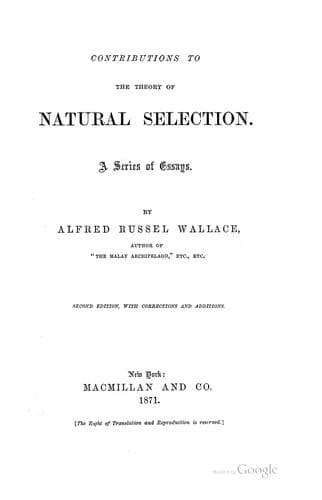
Contributions to the Theory of Natural Selection: A Series of EssaysWallace, Alfred Russel
Science
Contributions to the Theory of Natural Selection: A Series of Essays
Wallace, Alfred Russel
Natural selection
But there is another class of human faculties that do not regard our
fellow men, and which cannot, therefore, be thus accounted for. Such are
the capacity to form ideal conceptions of space and time, of eternity
and infinity--the capacity for intense artistic feelings of pleasure, in
form, colour, and composition--and for those abstract notions of form
and number which render geometry and arithmetic possible. How were all
or any of these faculties first developed, when they could have been of
no possible use to man in his early stages of barbarism? How could
"natural selection," or survival of the fittest in the struggle for
existence, at all favour the development of mental powers so entirely
removed from the material necessities of savage men, and which even now,
with our comparatively high civilization, are, in their farthest
developments, in advance of the age, and appear to have relation rather
to the future of the race than to its actual status?
_Difficulty as to the Origin of the Moral Sense._
Exactly the same difficulty arises, when we endeavour to account for the
development of the moral sense or conscience in savage man; for although
the _practice_ of benevolence, honesty, or truth, may have been useful
to the tribe possessing these virtues, that does not at all account for
the peculiar _sanctity_, attached to actions which each tribe considers
right and moral, as contrasted with the very different feelings with
which they regard what is merely _useful_. The utilitarian hypothesis
(which is the theory of natural selection applied to the mind) seems
inadequate to account for the development of the moral sense. This
subject has been recently much discussed, and I will here only give one
example to illustrate my argument. The utilitarian sanction for
truthfulness is by no means very powerful or universal. Few laws enforce
it. No very severe reprobation follows untruthfulness. In all ages and
countries, falsehood has been thought allowable in love, and laudable in
war; while, at the present day, it is held to be venial by the majority
of mankind, in trade, commerce, and speculation. A certain amount of
untruthfulness is a necessary part of politeness in the east and west
alike, while even severe moralists have held a lie justifiable, to elude
an enemy or prevent a crime. Such being the difficulties with which this
virtue has had to struggle, with so many exceptions to its practice,
with so many instances in which it brought ruin or death to its too
ardent devotee, how can we believe that considerations of utility could
ever invest it with the mysterious sanctity of the highest
virtue,--could ever induce men to value truth for its own sake, and
practice it regardless of consequences?
Public-domain text, read in full here on John Shaqi.
Reviews
Reviews
No reviews yet
Be the first to share your thoughts on this work.
Elsewhere in the archive
Join the Discussion
Join the discussion
Sign in to leave a comment or review.
Sign InorCreate an account