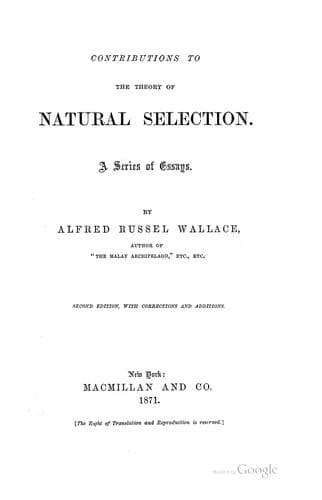
Contributions to the Theory of Natural Selection: A Series of EssaysWallace, Alfred Russel
Science
Contributions to the Theory of Natural Selection: A Series of Essays
Wallace, Alfred Russel
Natural selection
Another important series of facts, quite in accordance with, and even
necessary deductions from, the law now developed, are those of
rudimentary organs. That these really do exist, and in most cases have
no special function in the animal oeconomy, is admitted by the first
authorities in comparative anatomy. The minute limbs hidden beneath the
skin in many of the snake-like lizards, the anal hooks of the boa
constrictor, the complete series of jointed finger-bones in the paddle
of the Manatus and whale, are a few of the most familiar instances. In
botany a similar class of facts has been long recognised. Abortive
stamens, rudimentary floral envelopes and undeveloped carpels, are of
the most frequent occurrence. To every thoughtful naturalist the
question must arise, What are these for? What have they to do with the
great laws of creation? Do they not teach us something of the system of
Nature? If each species has been created independently, and without any
necessary relations with pre-existing species, what do these rudiments,
these apparent imperfections mean? There must be a cause for them; they
must be the necessary results of some great natural law. Now, if, as it
has been endeavoured to be shown, the great law which has regulated the
peopling of the earth with animal and vegetable life is, that every
change shall be gradual; that no new creature shall be formed widely
differing from anything before existing; that in this, as in everything
else in Nature, there shall be gradation and harmony,--then these
rudimentary organs are necessary, and are an essential part of the
system of Nature. Ere the higher Vertebrata were formed, for instance,
many steps were required, and many organs had to undergo modifications
from the rudimental condition in which only they had as yet existed. We
still see remaining an antitypal sketch of a wing adapted for flight in
the scaly flapper of the penguin, and limbs first concealed beneath the
skin, and then weakly protruding from it, were the necessary gradations
before others should be formed fully adapted for locomotion.[C] Many
more of these modifications should we behold, and more complete series
of them, had we a view of all the forms which have ceased to live. The
great gaps that exist between fishes, reptiles, birds, and mammals would
then, no doubt, be softened down by intermediate groups, and the whole
organic world would be seen to be an unbroken and harmonious system.
+--------------------------------------------------------------+
| [C] The theory of Natural Selection has now taught us that |
| these are not the steps by which limbs have been formed; and |
| that most rudimentary organs have been produced by abortion, |
| owing to disuse, as explained by Mr. Darwin. |
+--------------------------------------------------------------+
_Conclusion._
Public-domain text, read in full here on John Shaqi.
Reviews
Reviews
No reviews yet
Be the first to share your thoughts on this work.
Join the Discussion
Join the discussion
Sign in to leave a comment or review.
Sign InorCreate an account