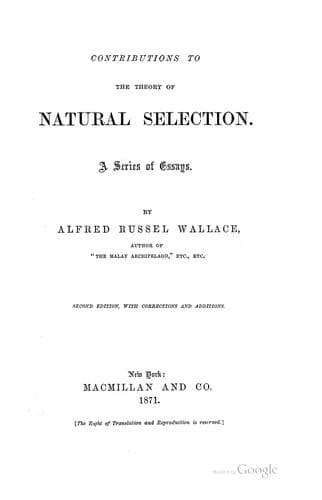
Contributions to the Theory of Natural Selection: A Series of EssaysWallace, Alfred Russel
Science
Contributions to the Theory of Natural Selection: A Series of Essays
Wallace, Alfred Russel
Natural selection
Again, in the domesticated animal all variations have an equal chance of
continuance; and those which would decidedly render a wild animal unable
to compete with its fellows and continue its existence are no
disadvantage whatever in a state of domesticity. Our quickly fattening
pigs, short-legged sheep pouter pigeons, and poodle dogs could never
have come into existence in a state of nature, because the very first
step towards such inferior forms would have led to the rapid extinction
of the race; still less could they now exist in competition with their
wild allies. The great speed but slight endurance of the race horse, the
unwieldy strength of the ploughman's team, would both be useless in a
state of nature. If turned wild on the pampas, such animals would
probably soon become extinct, or under favourable circumstances might
each gradually lose those extreme qualities which would never be called
into action, and in a few generations revert to a common type, which
must be that in which the various powers and faculties are so
proportioned to each other as to be best adapted to procure food and
secure safety,--that in which by the full exercise of every part of its
organisation the animal can alone continue to live. Domestic varieties,
when turned wild, _must_ return to something near the type of the
original wild stock, _or become altogether extinct_.[F]
+--------------------------------------------------------------+
| [F] That is, they will vary, and the variations which tend |
| to adapt them to the wild state, and therefore approximate |
| them to wild animals, will be preserved. Those individuals |
| which do not vary sufficiently will perish. |
+--------------------------------------------------------------+
We see, then, that no inferences as to the permanence of varieties in a
state of nature can be deduced from the observations of those occurring
among domestic animals. The two are so much opposed to each other in
every circumstance of their existence, that what applies to the one is
almost sure not to apply to the other. Domestic animals are abnormal,
irregular, artificial; they are subject to variations which never occur
and never can occur in a state of nature: their very existence depends
altogether on human care; so far are many of them removed from that just
proportion of faculties, that true balance of organisation, by means of
which alone an animal left to its own resources can preserve its
existence and continue its race.
_Lamarck's Hypothesis very different from that now advanced._
Public-domain text, read in full here on John Shaqi.
Reviews
Reviews
No reviews yet
Be the first to share your thoughts on this work.
Join the Discussion
Join the discussion
Sign in to leave a comment or review.
Sign InorCreate an account