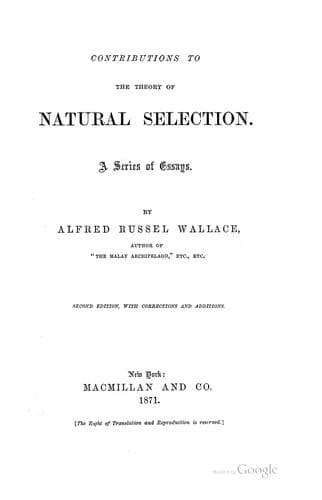
Contributions to the Theory of Natural Selection: A Series of EssaysWallace, Alfred Russel
Science
Contributions to the Theory of Natural Selection: A Series of Essays
Wallace, Alfred Russel
Natural selection
The Rev. Joseph Greene has called attention to the striking harmony
between the colours of those British moths which are on the wing in
autumn and winter, and the prevailing tints of nature at those seasons.
In autumn various shades of yellow and brown prevail, and he shows that
out of fifty-two species that fly at this season, no less than forty-two
are of corresponding colours. Orgyia antiqua, O. gonostigma, the genera
Xanthia, Glaea, and Ennomos are examples. In winter, gray and silvery
tints prevail, and the genus Chematobia and several species of Hybernia
which fly during this season are of corresponding hues. No doubt if the
habits of moths in a state of nature were more closely observed, we
should find many cases of special protective resemblance. A few such
have already been noticed. Agriopis aprilina, Acronycta psi, and many
other moths which rest during the day on the north side of the trunks of
trees can with difficulty be distinguished from the grey and green
lichens that cover them. The lappet moth (Gastropacha querci) closely
resembles both in shape and colour a brown dry leaf; and the well-known
buff-tip moth, when at rest is like the broken end of a lichen-covered
branch. There are some of the small moths which exactly resemble the
dung of birds dropped on leaves, and on this point Mr. A. Sidgwick, in a
paper read before the Rugby School Natural History Society, gives the
following original observation:--"I myself have more than once mistaken
Cilix compressa, a little white and grey moth, for a piece of bird's
dung dropped upon a leaf, and _vice versa_ the dung for the moth.
Bryophila Glandifera and Perla are the very image of the mortar walls on
which they rest; and only this summer, in Switzerland, I amused myself
for some time in watching a moth, probably Larentia tripunctaria,
fluttering about quite close to me, and then alighting on a wall of the
stone of the district which it so exactly matched as to be quite
invisible a couple of yards off." There are probably hosts of these
resemblances which have not been observed, owing to the difficulty of
finding many of the species in their stations of natural repose.
Caterpillars are also similarly protected. Many exactly resemble in tint
the leaves they feed upon; others are like little brown twigs, and many
are so strangely marked or humped, that when motionless they can hardly
be taken to be living creatures at all. Mr. Andrew Murray has remarked
how closely the larva of the peacock moth (Saturnia pavonia-minor)
harmonizes in its ground colour with that of the young buds of heather
on which it feeds, and that the pink spots with which it is decorated
correspond with the flowers and flower-buds of the same plant.
Public-domain text, read in full here on John Shaqi.
Reviews
Reviews
No reviews yet
Be the first to share your thoughts on this work.
Join the Discussion
Join the discussion
Sign in to leave a comment or review.
Sign InorCreate an account