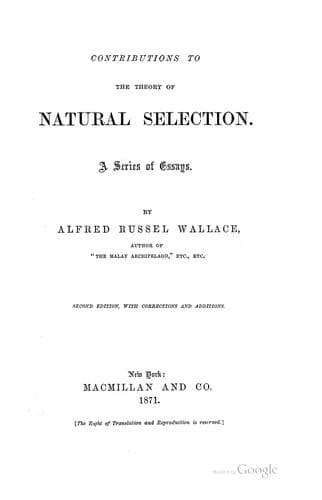
Contributions to the Theory of Natural Selection: A Series of EssaysWallace, Alfred Russel
Science
Contributions to the Theory of Natural Selection: A Series of Essays
Wallace, Alfred Russel
Natural selection
It may fairly be expected that if these imitations of one creature by
another really serve as a protection to weak and decaying species,
instances of the same kind will be found among other groups than the
Lepidoptera; and such is the case, although they are seldom so prominent
and so easily recognised as those already pointed out as occurring in
that order. A few very interesting examples may, however, be pointed out
in most of the other orders of insects. The Coleoptera or beetles that
imitate other Coleoptera of distinct groups are very numerous in
tropical countries, and they generally follow the laws already laid down
as regulating these phenomena. The insects which others imitate always
have a special protection, which leads them to be avoided as dangerous
or uneatable by small insectivorous animals; some have a disgusting
taste (analogous to that of the Heliconidae); others have such a hard and
stony covering that they cannot be crushed or digested; while a third
set are very active, and armed with powerful jaws, as well as having
some disagreeable secretion. Some species of Eumorphidae and Hispidae,
small flat or hemispherical beetles which are exceedingly abundant, and
have a disagreeable secretion, are imitated by others of the very
distinct group of Longicornes (of which our common musk-beetle may be
taken as an example). The extraordinary little Cyclopeplus batesii,
belongs to the same sub-family of this group as the Onychocerus scorpio
and O. concentricus, which have already been adduced as imitating with
such wonderful accuracy the bark of the trees they habitually frequent;
but it differs totally in outward appearance from every one of its
allies, having taken upon itself the exact shape and colouring of a
globular Corynomalus, a little stinking beetle with clubbed antennae. It
is curious to see how these clubbed antennae are imitated by an insect
belonging to a group with long slender antennae. The sub-family
Anisocerinae, to which Cyclopeplus belongs, is characterised by all its
members possessing a little knob or dilatation about the middle of the
antennae. This knob is considerably enlarged in C. batesii, and the
terminal portion of the antennae beyond it is so small and slender as to
be scarcely visible, and thus an excellent substitute is obtained for
the short clubbed antennae of the Corynomalus. Erythroplatis corallifer
is another curious broad flat beetle, that no one would take for a
Longicorn, since it almost exactly resembles Cephalodonta spinipes, one
of the commonest of the South American Hispidae; and what is still more
remarkable, another Longicorn of a distinct group, Streptolabis
hispoides, was found by Mr. Bates, which resembles the same insect with
equal minuteness,--a case exactly parallel to that among butterflies,
where species of two or three distinct groups mimicked the same
Heliconia. Many of the soft-winged beetles (Malacoderms) are excessively
Public-domain text, read in full here on John Shaqi.
Reviews
Reviews
No reviews yet
Be the first to share your thoughts on this work.
Elsewhere in the archive
Join the Discussion
Join the discussion
Sign in to leave a comment or review.
Sign InorCreate an account