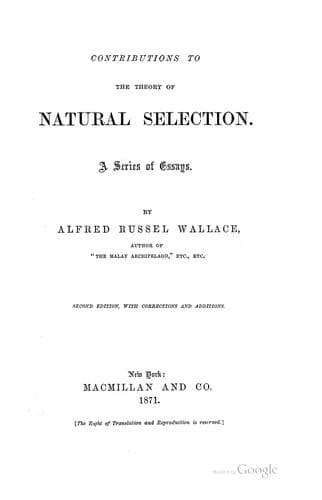
Contributions to the Theory of Natural Selection: A Series of EssaysWallace, Alfred Russel
Science
Contributions to the Theory of Natural Selection: A Series of Essays
Wallace, Alfred Russel
Natural selection
abundant in individuals, and it is probable that they have some similar
protection, more especially as other species often strikingly resemble
them. A Longicorn beetle, Paeciloderma terminale, found in Jamaica, is
coloured exactly in the same way as a Lycus (one of the Malacoderms)
from the same island. Eroschema poweri, a Longicorn from Australia,
might certainly be taken for one of the same group, and several species
from the Malay Islands are equally deceptive. In the Island of Celebes I
found one of this group, having the whole body and elytra of a rich deep
blue colour, with the head only orange; and in company with it an insect
of a totally different family (Eucnemidae) with identically the same
colouration, and of so nearly the same size and form as to completely
puzzle the collector on every fresh occasion of capturing them. I have
been recently informed by Mr. Jenner Weir, who keeps a variety of small
birds, that none of them will touch our common "soldiers and sailors"
(species of Malacoderms), thus confirming my belief that they were a
protected group, founded on the fact of their being at once very
abundant, of conspicuous colours, and the objects of mimicry.
There are a number of the larger tropical weevils which have the
elytra and the whole covering of the body so hard as to be a great
annoyance to the entomologist, because in attempting to transfix them
the points of his pins are constantly turned. I have found it necessary
in these cases to drill a hole very carefully with the point of a
sharp penknife before attempting to insert a pin. Many of the fine
long-antennaed Anthribidae (an allied group) have to be treated in the
same way. We can easily understand that after small birds have in vain
attempted to eat these insects, they should get to know them by sight,
and ever after leave them alone, and it will then be an advantage for
other insects which are comparatively soft and eatable, to be mistaken
for them. We need not be surprised, therefore, to find that there are
many Longicorns which strikingly resemble the "hard beetles" of their
own district. In South Brazil, Acanthotritus dorsalis is strikingly
like a Curculio of the hard genus Heiliplus, and Mr. Bates assures me
that he found Gymnocerus cratosomoides (a Longicorn) on the same tree
with a hard Cratosomus (a weevil), which it exactly mimics. Again, the
pretty Longicorn, Phacellocera batesii, mimics one of the hard
Anthribidae of the genus Ptychoderes, having long slender antennae. In the
Moluccas we find Cacia anthriboides, a small Longicorn which might be
easily mistaken for a very common species of Anthribidae found in the
same districts; and the very rare Capnolymma stygium closely imitates
the common Mecocerus gazella, which abounded where it was taken. Doliops
curculionoides and other allied Longicorns from the Philippine Islands
most curiously resemble, both in form and colouring, the brilliant
Public-domain text, read in full here on John Shaqi.
Reviews
Reviews
No reviews yet
Be the first to share your thoughts on this work.
Elsewhere in the archive
Join the Discussion
Join the discussion
Sign in to leave a comment or review.
Sign InorCreate an account