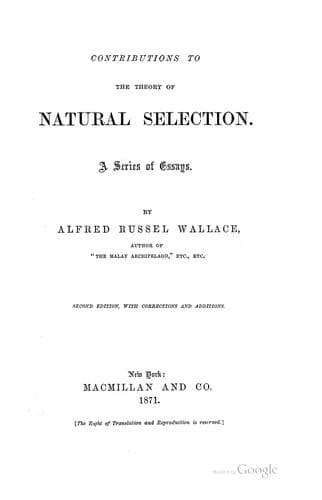
Contributions to the Theory of Natural Selection: A Series of EssaysWallace, Alfred Russel
Science
Contributions to the Theory of Natural Selection: A Series of Essays
Wallace, Alfred Russel
Natural selection
Pachyrhynchi,--Curculionidae, which are almost peculiar to that group of
islands. The remaining family of Coleoptera most frequently imitated is
the Cicindelidae. The rare and curious Longicorn, Collyrodes lacordairei,
has exactly the form and colouring of the genus Collyris, while an
undescribed species of Heteromera is exactly like a Therates, and was
taken running on the trunks of trees, as is the habit of that group.
There is one curious example of a Longicorn mimicking a Longicorn, like
the Papilios and Heliconidae which mimic their own allies. Agnia
fasciata, belonging to the sub-family Hypselominae, and Nemophas grayi,
belonging to the Lamiinae, were taken in Amboyna on the same fallen tree
at the same time, and were supposed to be the same species till they
were more carefully examined, and found to be structurally quite
different. The colouring of these insects is very remarkable, being rich
steel-blue black, crossed by broad hairy bands of orange buff, and out
of the many thousands of known species of Longicorns they are probably
the only two which are so coloured. The Nemophas grayi is the larger,
stronger, and better armed insect, and belongs to a more widely spread
and dominant group, very rich in species and individuals, and is
therefore most probably the subject of mimicry by the other species.
_Beetles mimicking other Insects._
We will now adduce a few cases in which beetles imitate other insects,
and insects of other orders imitate beetles.
Charis melipona, a South American Longicorn of the family Necydalidae,
has been so named from its resemblance to a small bee of the genus
Melipona. It is one of the most remarkable cases of mimicry, since the
beetle has the thorax and body densely hairy like the bee, and the legs
are tufted in a manner most unusual in the order Coleoptera. Another
Longicorn, Odontocera odyneroides, has the abdomen banded with yellow,
and constricted at the base, and is altogether so exactly like a small
common wasp of the genus Odynerus, that Mr. Bates informs us he was
afraid to take it out of his net with his fingers for fear of being
stung. Had Mr. Bates's taste for insects been less omnivorous than it
was, the beetle's disguise might have saved it from his pin, as it had
no doubt often done from the beak of hungry birds. A larger insect,
Sphecomorpha chalybea, is exactly like one of the large metallic blue
wasps, and like them has the abdomen connected with the thorax by a
pedicel, rendering the deception most complete and striking. Many
Eastern species of Longicorns of the genus Oberea, when on the wing
exactly resemble Tenthredinidae, and many of the small species of
Hesthesis run about on timber, and cannot be distinguished from ants.
There is one genus of South American Longicorns that appears to mimic
the shielded bugs of the genus Scutellera. The Gymnocerous capucinus is
one of these, and is very like Pachyotris fabricii, one of the
Scutelleridae.
Public-domain text, read in full here on John Shaqi.
Reviews
Reviews
No reviews yet
Be the first to share your thoughts on this work.
Elsewhere in the archive
Join the Discussion
Join the discussion
Sign in to leave a comment or review.
Sign InorCreate an account