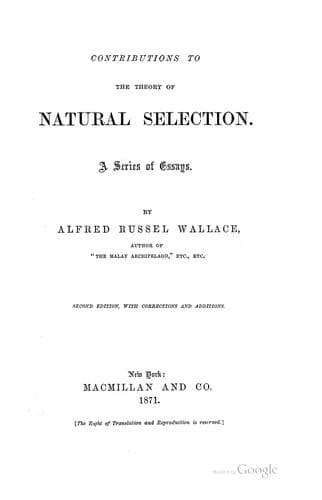
Contributions to the Theory of Natural Selection: A Series of EssaysWallace, Alfred Russel
Science
Contributions to the Theory of Natural Selection: A Series of Essays
Wallace, Alfred Russel
Natural selection
My friend, Mr. Osbert Salvin, has given me another interesting case of
bird mimicry. In the neighbourhood of Rio Janeiro is found an
insect-eating hawk (Harpagus diodon), and in the same district a
bird-eating hawk (Accipiter pileatus) which closely resembles it. Both
are of the same ashy tint beneath, with the thighs and under
wing-coverts reddish brown, so that when on the wing and seen from below
they are undistinguishable. The curious point, however, is that the
Accipiter has a much wider range than the Harpagus, and in the regions
where the insect-eating species is not found it no longer resembles it,
the under wing-coverts varying to white; thus indicating that the
red-brown colour is kept true by its being useful to the Accipiter to be
mistaken for the insect-eating species, which birds have learnt not to
be afraid of.
_Mimicry among Mammals._
Among the Mammalia the only case which may be true mimicry is that of
the insectivorous genus Cladobates, found in the Malay countries,
several species of which very closely resemble squirrels. The size is
about the same, the long bushy tail is carried in the same way, and the
colours are very similar. In this case the use of the resemblance must
be to enable the Cladobates to approach the insects or small birds on
which it feeds, under the disguise of the harmless fruit-eating
squirrel.
_Objections to Mr. Bates' Theory of Mimicry._
Having now completed our survey of the most prominent and remarkable
cases of mimicry that have yet been noticed, we must say something of
the objections that have been made to the theory of their production
given by Mr. Bates, and which we have endeavoured to illustrate and
enforce in the preceding pages. Three counter explanations have been
proposed. Professor Westwood admits the fact of the mimicry and its
probable use to the insect, but maintains that each species was created
a mimic for the purpose of the protection thus afforded it. Mr. Andrew
Murray, in his paper on the "Disguises of Nature," inclines to the
opinion that similar conditions of food and of surrounding circumstances
have acted in some unknown way to produce the resemblances; and when the
subject was discussed before the Entomological Society of London, a
third objection was added--that heredity or the reversion to ancestral
types of form and colouration, might have produced many of the cases of
mimicry.
Public-domain text, read in full here on John Shaqi.
Reviews
Reviews
No reviews yet
Be the first to share your thoughts on this work.
Elsewhere in the archive
Join the Discussion
Join the discussion
Sign in to leave a comment or review.
Sign InorCreate an account