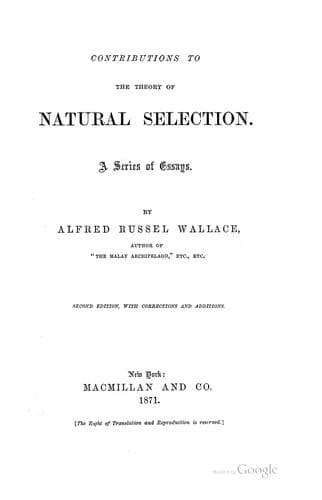
Contributions to the Theory of Natural Selection: A Series of EssaysWallace, Alfred Russel
Science
Contributions to the Theory of Natural Selection: A Series of Essays
Wallace, Alfred Russel
Natural selection
Against the special creation of mimicking species there are all the
objections and difficulties in the way of special creation in other
cases, with the addition of a few that are peculiar to it. The most
obvious is, that we have gradations of mimicry and of protective
resemblance--a fact which is strongly suggestive of a natural process
having been at work. Another very serious objection is, that as mimicry
has been shown to be useful only to those species and groups which are
rare and probably dying out, and would cease to have any effect should
the proportionate abundance of the two species be reversed, it follows
that on the special-creation theory the one species must have been
created plentiful, the other rare; and, notwithstanding the many causes
that continually tend to alter the proportions of species, these two
species must have always been specially maintained at their respective
proportions, or the very purpose for which they each received their
peculiar characteristics would have completely failed. A third
difficulty is, that although it is very easy to understand how mimicry
may be brought about by variation and the survival of the fittest, it
seems a very strange thing for a Creator to protect an animal by making
it imitate another, when the very assumption of a Creator implies his
power to create it so as to require no such circuitous protection. These
appear to be fatal objections to the application of the special-creation
theory to this particular case.
The other two supposed explanations, which may be shortly expressed as
the theories of "similar conditions" and of "heredity," agree in making
mimicry, where it exists, an adventitious circumstance not necessarily
connected with the well-being of the mimicking species. But several of
the most striking and most constant facts which have been adduced,
directly contradict both those hypotheses. The law that mimicry is
confined to a few groups only is one of these, for "similar conditions"
must act more or less on all groups in a limited region, and "heredity"
must influence all groups related to each other in an equal degree.
Again, the general fact that those species which mimic others are rare,
while those which are imitated are abundant, is in no way explained by
either of these theories, any more than is the frequent occurrence of
some palpable mode of protection in the imitated species. "Reversion to
an ancestral type" no way explains why the imitator and the imitated
always inhabit the very same district, whereas allied forms of every
degree of nearness and remoteness generally inhabit different countries,
and often different quarters of the globe; and neither it, nor "similar
conditions," will account for the likeness between species of distinct
groups being superficial only--a disguise, not a true resemblance; for
the imitation of bark, of leaves, of sticks, of dung; for the
resemblance between species in different orders, and even different
Public-domain text, read in full here on John Shaqi.
Reviews
Reviews
No reviews yet
Be the first to share your thoughts on this work.
Elsewhere in the archive
Join the Discussion
Join the discussion
Sign in to leave a comment or review.
Sign InorCreate an account