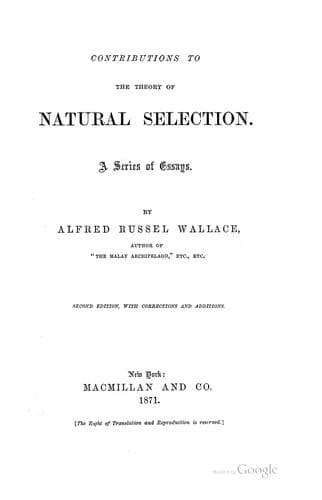
Contributions to the Theory of Natural Selection: A Series of EssaysWallace, Alfred Russel
Science
Contributions to the Theory of Natural Selection: A Series of Essays
Wallace, Alfred Russel
Natural selection
_Use of the gaudy Colours of many Caterpillars._
Since this essay was first published a very curious difficulty has been
cleared up by the application of the general principle of protective
colouring. Great numbers of caterpillars are so brilliantly marked and
coloured as to be very conspicuous even at a considerable distance, and
it has been noticed that such caterpillars seldom hide themselves. Other
species, however, are green or brown, closely resembling the colours of
the substances on which they feed, while others again imitate sticks,
and stretch themselves out motionless from a twig so as to look like one
of its branches. Now, as caterpillars form so large a part of the food
of birds, it was not easy to understand why any of them should have such
bright colours and markings as to make them specially visible. Mr.
Darwin had put the case to me as a difficulty from another point of
view, for he had arrived at the conclusion that brilliant colouration in
the animal kingdom is mainly due to sexual selection, and this could not
have acted in the case of sexless larvae. Applying here the analogy of
other insects, I reasoned, that since some caterpillars were evidently
protected by their imitative colouring, and others by their spiny or
hairy bodies, the bright colours of the rest must also be in some way
useful to them. I further thought that as some butterflies and moths
were greedily eaten by birds while others were distasteful to them, and
these latter were mostly of conspicuous colours, so probably these
brilliantly coloured caterpillars were distasteful, and therefore never
eaten by birds. Distastefulness alone would however be of little service
to caterpillars, because their soft and juicy bodies are so delicate,
that if seized and afterwards rejected by a bird they would almost
certainly be killed. Some constant and easily perceived signal was
therefore necessary to serve as a warning to birds never to touch these
uneatable kinds, and a very gaudy and conspicuous colouring with the
habit of fully exposing themselves to view becomes such a signal, being
in strong contrast with the green or brown tints and retiring habits of
the eatable kinds. The subject was brought by me before the
Entomological Society (see Proceedings, March 4th, 1867), in order that
those members having opportunities for making observations might do so
in the following summer; and I also wrote a letter to the _Field_
newspaper, begging that some of its readers would co-operate in making
observations on what insects were rejected by birds, at the same time
fully explaining the great interest and scientific importance of the
problem. It is a curious example of how few of the country readers of
that paper are at all interested in questions of simple natural history,
that I only obtained one answer from a gentleman in Cumberland, who gave
me some interesting observations on the general dislike and abhorrence
Public-domain text, read in full here on John Shaqi.
Reviews
Reviews
No reviews yet
Be the first to share your thoughts on this work.
Elsewhere in the archive
Join the Discussion
Join the discussion
Sign in to leave a comment or review.
Sign InorCreate an account