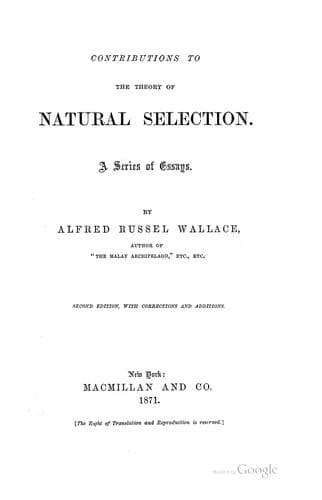
Contributions to the Theory of Natural Selection: A Series of EssaysWallace, Alfred Russel
Science
Contributions to the Theory of Natural Selection: A Series of Essays
Wallace, Alfred Russel
Natural selection
of all birds to the "Gooseberry Caterpillar," probably that of the
Magpie-moth (Abraxas grossulariata). Neither young pheasants,
partridges, nor wild-ducks could be induced to eat it, sparrows and
finches never touched it, and all birds to whom he offered it rejected
it with evident dread and abhorrence. It will be seen that these
observations are confirmed by those of two members of the Entomological
Society to whom we are indebted for more detailed information.
In March, 1869, Mr. J. Jenner Weir communicated a valuable series of
observations made during many years, but more especially in the two
preceding summers, in his aviary, containing the following birds of more
or less insectivorous habits:--Robin, Yellow-Hammer, Reed-bunting,
Bullfinch, Chaffinch, Crossbill, Thrush, Tree-Pipit, Siskin, and
Redpoll. He found that hairy caterpillars were uniformly rejected; five
distinct species were quite unnoticed by all his birds, and were allowed
to crawl about the aviary for days with impunity. The spiny caterpillars
of the Tortoiseshell and Peacock butterflies were equally rejected; but
in both these cases Mr. Weir thinks it is the taste, not the hairs or
spines, that are disagreeable, because some very young caterpillars of a
hairy species were rejected although no hairs were developed, and the
smooth pupae of the above-named butterflies were refused as persistently
as the spined larvae. In these cases, then, both hairs and spines would
seem to be mere signs of uneatableness.
His next experiments were with those smooth gaily-coloured caterpillars
which never conceal themselves, but on the contrary appear to court
observation. Such are those of the Magpie moth (Abraxas grossulariata),
whose caterpillar is conspicuously white and black spotted--the Diloba
coeruleocephala, whose larvae is pale yellow with a broad blue or green
lateral band--the Cucullia verbasci, whose larvae is greenish white with
yellow bands and black spots, and Anthrocera filipendulae (the six spot
Burnet moth), whose caterpillar is yellow with black spots. These were
given to the birds at various times, sometimes mixed with other kinds of
larvae which were greedily eaten, but they were in every case rejected
apparently unnoticed, and were left to crawl about till they died.
The next set of observations were on the dull-coloured and protected
larvae, and the results of numerous experiments are thus summarised by
Mr. Weir. "All caterpillars whose habits are nocturnal, which are dull
coloured, with fleshy bodies and smooth skins, are eaten with the
greatest avidity. Every species of green caterpillar is also much
relished. All Geometrae, whose larvae resemble twigs as they stand out
from the plant on their anal prolegs, are invariably eaten."
Public-domain text, read in full here on John Shaqi.
Reviews
Reviews
No reviews yet
Be the first to share your thoughts on this work.
Elsewhere in the archive
Join the Discussion
Join the discussion
Sign in to leave a comment or review.
Sign InorCreate an account