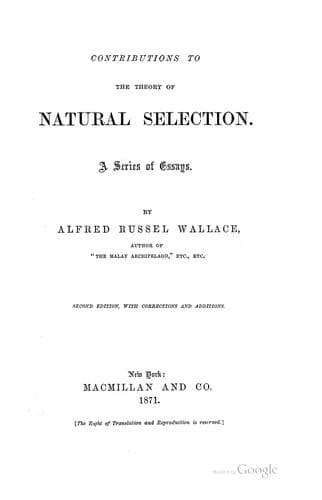
Contributions to the Theory of Natural Selection: A Series of EssaysWallace, Alfred Russel
Science
Contributions to the Theory of Natural Selection: A Series of Essays
Wallace, Alfred Russel
Natural selection
The Brain of the Savage shown to be Larger than he Needs it to be
Size of Brain an important Element of Mental Power
Comparison of the Brains of Man and of Anthropoid Apes
Range of intellectual power in Man
Intellect of Savages and of Animals compared
The use of the Hairy Covering of Mammalia
The Constant absence of Hair from certain parts of Man's body a
remarkable Phenomenon
Savage Man feels the want of this Hairy Covering
Man's Naked Skin could not have been produced by Natural Selection
Feet and Hands of Man considered as Difficulties on the Theory of
Natural Selection
The Origin of Some of Man's Mental Faculties, by the preservation of
Useful Variations, not possible
Difficulty as to the Origin of the Moral Sense
Summary of the Argument as to the Insufficiency of Natural Selection
to account for the Development of Man
The Origin of Consciousness
The Nature of Matter
Matter is Force
All Force is probably Will-force
Conclusion
I.
ON THE LAW WHICH HAS REGULATED THE INTRODUCTION OF NEW SPECIES.[A]
+--------------------------------------------------------------+
| [A] Written at Sarawak in February, 1855, and published in |
| the "Annals and Magazine of Natural History," September, |
| 1855. |
+--------------------------------------------------------------+
_Geographical Distribution dependent on Geologic Changes._
Every naturalist who has directed his attention to the subject of the
geographical distribution of animals and plants, must have been
interested in the singular facts which it presents. Many of these facts
are quite different from what would have been anticipated, and have
hitherto been considered as highly curious, but quite inexplicable. None
of the explanations attempted from the time of Linnaeus are now
considered at all satisfactory; none of them have given a cause
sufficient to account for the facts known at the time, or comprehensive
enough to include all the new facts which have since been, and are daily
being added. Of late years, however, a great light has been thrown upon
the subject by geological investigations, which have shown that the
present state of the earth and of the organisms now inhabiting it, is
but the last stage of a long and uninterrupted series of changes which
it has undergone, and consequently, that to endeavour to explain and
account for its present condition without any reference to those changes
(as has frequently been done) must lead to very imperfect and erroneous
conclusions.
Public-domain text, read in full here on John Shaqi.
Reviews
Reviews
No reviews yet
Be the first to share your thoughts on this work.
Join the Discussion
Join the discussion
Sign in to leave a comment or review.
Sign InorCreate an account