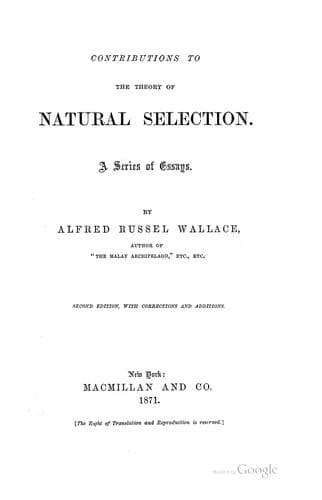
Contributions to the Theory of Natural Selection: A Series of EssaysWallace, Alfred Russel
Science
Contributions to the Theory of Natural Selection: A Series of Essays
Wallace, Alfred Russel
Natural selection
The important part that "protective resemblance" has played in
determining the colours and markings of many groups of animals, will
enable us to understand the meaning of one of the most striking facts in
nature, the uniformity in the colours of the vegetable as compared with
the wonderful diversity of the animal world. There appears no good
reason why trees and shrubs should not have been adorned with as many
varied hues and as strikingly designed patterns as birds and
butterflies, since the gay colours of flowers show that there is no
incapacity in vegetable tissues to exhibit them. But even flowers
themselves present us with none of those wonderful designs, those
complicated arrangements of stripes and dots and patches of colour,
that harmonious blending of hues in lines and bands and shaded spots,
which are so general a feature in insects. It is the opinion of Mr.
Darwin that we owe much of the beauty of flowers to the necessity of
attracting insects to aid in their fertilisation, and that much of the
development of colour in the animal world is due to "sexual selection,"
colour being universally attractive, and thus leading to its propagation
and increase; but while fully admitting this, it will be evident from
the facts and arguments here brought forward, that very much of the
_variety_ both of colour and markings among animals is due to the
supreme importance of concealment, and thus the various tints of
minerals and vegetables have been directly reproduced in the animal
kingdom, and again and again modified as more special protection became
necessary. We shall thus have two causes for the development of colour
in the animal world, and shall be better enabled to understand how, by
their combined and separate action, the immense variety we now behold
has been produced. Both causes, however, will come under the general law
of "Utility," the advocacy of which, in its broadest sense, we owe
almost entirely to Mr. Darwin. A more accurate knowledge of the varied
phenomena connected with this subject may not improbably give us some
information both as to the senses and the mental faculties of the lower
animals. For it is evident that if colours which please us also attract
them, and if the various disguises which have been here enumerated are
equally deceptive to them as to ourselves, then both their powers of
vision and their faculties of perception and emotion, must be
essentially of the same nature as our own--a fact of high philosophical
importance in the study of our own nature and our true relations to the
lower animals.
_Conclusion._
Public-domain text, read in full here on John Shaqi.
Reviews
Reviews
No reviews yet
Be the first to share your thoughts on this work.
Elsewhere in the archive
Join the Discussion
Join the discussion
Sign in to leave a comment or review.
Sign InorCreate an account