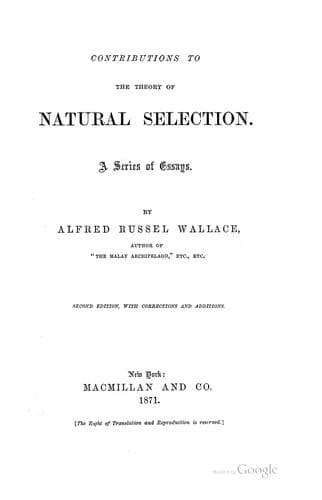
Contributions to the Theory of Natural Selection: A Series of EssaysWallace, Alfred Russel
Science
Contributions to the Theory of Natural Selection: A Series of Essays
Wallace, Alfred Russel
Natural selection
is of the same nature in the two cases, by the occurrence in the same
group of one species resembling a vegetable substance, while another
resembles a living animal of another group; and we know that the
creatures resembled, possess an immunity from attack, by their being
always very abundant, by their being conspicuous and not concealing
themselves, and by their having generally no visible means of escape
from their enemies; while, at the same time, the particular quality that
makes them disliked is often very clear, such as a nasty taste or an
indigestible hardness. Further examination reveals the fact that, in
several cases of both kinds of disguise, it is the female only that is
thus disguised; and as it can be shown that the female needs protection
much more than the male, and that her preservation for a much longer
period is absolutely necessary for the continuance of the race, we have
an additional indication that the resemblance is in all cases
subservient to a great purpose--the preservation of the species.
In endeavouring to explain these phenomena as having been brought about
by variation and natural selection, we start with the fact that white
varieties frequently occur, and when protected from enemies show no
incapacity for continued existence and increase. We know, further, that
varieties of many other tints occasionally occur; and as "the survival
of the fittest" must inevitably weed out those whose colours are
prejudicial and preserve those whose colours are a safeguard, we require
no other mode of accounting for the protective tints of arctic and
desert animals. But this being granted, there is such a perfectly
continuous and graduated series of examples of every kind of protective
imitation, up to the most wonderful cases of what is termed "mimicry,"
that we can find no place at which to draw the line, and say,--so far
variation and natural selection will account for the phenomena, but for
all the rest we require a more potent cause. The counter theories that
have been proposed, that of the "special creation" of each imitative
form, that of the action of "similar conditions of existence" for some
of the cases, and of the laws of "hereditary descent and the reversion
to ancestral forms" for others,--have all been shown to be beset with
difficulties, and the two latter to be directly contradicted by some of
the most constant and most remarkable of the facts to be accounted for.
_General deductions as to Colour in Nature._
Public-domain text, read in full here on John Shaqi.
Reviews
Reviews
No reviews yet
Be the first to share your thoughts on this work.
Elsewhere in the archive
Join the Discussion
Join the discussion
Sign in to leave a comment or review.
Sign InorCreate an account