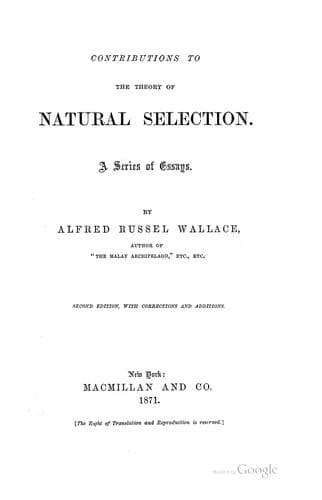
Contributions to the Theory of Natural Selection: A Series of EssaysWallace, Alfred Russel
Science
Contributions to the Theory of Natural Selection: A Series of Essays
Wallace, Alfred Russel
Natural selection
believe, therefore, that I shall be correct in placing P. Romulus as a
third Indian form of the female P. Pammon, corresponding to P.
Melanides, the third form of the Malayan P. Theseus. I may mention here
that the females of this group have a superficial resemblance to the
Polydorus group of Papilios, as shown by P. Theseus having been
considered to be the female of P. Antiphus, and by P. Romulus being
arranged next to P. Hector. There is no close affinity between these two
groups of Papilio, and I am disposed to believe that we have here a case
of mimicry, brought about by the same causes which Mr. Bates has so well
explained in his account of the Heliconidae, and which has led to the
singular exuberance of polymorphic forms in this and allied groups of
the genus Papilio. I shall have to devote a section of my essay to the
consideration of this subject.
The third example of polymorphism I have to bring forward is Papilio
Ormenus, which is closely allied to the well-known P. Erechtheus, of
Australia. The most common form of the female also resembles that of P.
Erechtheus; but a totally different-looking insect was found by myself
in the Aru Islands, and figured by Mr. Hewitson under the name of P.
Onesimus, which subsequent observation has convinced me is a second form
of the female of P. Ormenus. Comparison of this with Boisduval's
description of P. Amanga, a specimen of which from New Guinea is in the
Paris Museum, shows the latter to be a closely similar form; and two
other specimens were obtained by myself, one in the island of Goram and
the other in Waigiou, all evidently local modifications of the same
form. In each of these localities males and ordinary females of P.
Ormenus were also found. So far there is no evidence that these
light-coloured insects are not females of a distinct species, the males
of which have not been discovered. But two facts have convinced me this
is not the case. At Dorey, in New Guinea, where males and ordinary
females closely allied to P. Ormenus occur (but which seem to me worthy
of being separated as a distinct species), I found one of these
light-coloured females closely followed in her flight by three males,
exactly in the same manner as occurs (and, I believe, occurs only) with
the sexes of the same species. After watching them a considerable time,
I captured the whole of them, and became satisfied that I had discovered
the true relations of this anomalous form. The next year I had
corroborative proof of the correctness of this opinion by the discovery
in the island of Batchian of a new species allied to P. Ormenus, all the
females of which, either seen or captured by me, were of one form, and
much more closely resembling the abnormal light-coloured females of P.
Ormenus and P. Pandion than the ordinary specimens of that sex. Every
naturalist will, I think, agree that this is strongly confirmative of
the supposition that both forms of female are of one species; and when
Public-domain text, read in full here on John Shaqi.
Reviews
Reviews
No reviews yet
Be the first to share your thoughts on this work.
Elsewhere in the archive
Join the Discussion
Join the discussion
Sign in to leave a comment or review.
Sign InorCreate an account