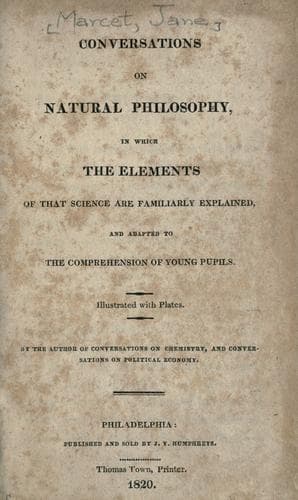
Conversations on Natural Philosophy, in which the Elements of that Science are Familiarly ExplainedMarcet, Mrs. (Jane Haldimand)
Science
Conversations on Natural Philosophy, in which the Elements of that Science are Familiarly Explained
Marcet, Mrs. (Jane Haldimand)
Physics
_Mrs. B._ Exactly so. These changes are called the phases of the moon,
and require some explanation. In fig. 2, plate 11, let us say, that S
represents the sun, E the earth, and A B C D E F G H, the moon, in
different parts of her orbit. When the moon is at A, her dark side being
turned towards the earth, we shall not see her as at _a_; but her
disappearance is of very short duration, and as she advances in her
orbit, we perceive her under the form of a new moon: when she has gone
through one eighth of her orbit at B, one quarter of her enlightened
hemisphere will be turned towards the earth, and she will then appear
horned as at _b_; when she has performed one quarter of her orbit, she
shows us one half of her enlightened side, as at _c_, and this is called
her first quarter; at _d_ she is said to be gibbous, and at _e_ the
whole of the enlightened side appears to us, and the moon is at full. As
she proceeds in her orbit, she becomes again gibbous, and her
enlightened hemisphere turns gradually away from us, until she arrives
at G, which is her third quarter; proceeding thence she completes her
orbit and disappears, and then again resumes her form of a new moon, and
passes successively, through the same changes.
When the moon is new, she is said to be in conjunction with the sun, as
they are then both in the same direction from the earth; at the time of
full moon, she is said to be in opposition, because she and the sun, are
at opposite sides of the earth; at the time of her first and third
quarters, she is said to be in her quadratures, because she is then
one-fourth of a circle, or 90°, from her conjunction, or the period of
new moon.
_Emily._ Are not the eclipses of the sun produced by the moon passing
between the sun and the earth?
_Mrs. B._ Yes; when the moon passes between the sun and the earth, she
intercepts his rays, or, in other words, casts a shadow on the earth,
then the sun is eclipsed, and daylight gives place to darkness, while
the moon's shadow is passing over us.
When, on the contrary, the earth is between the sun and the moon, it is
we who intercept the sun's rays, and cast a shadow on the moon; she is
then said to be eclipsed, and disappears from our view.
_Emily._ But as the moon goes round the earth every month, she must be,
once during that time, between the earth and the sun; and the earth must
likewise be once between the sun and the moon, and yet we have not a
solar and a lunar eclipse every month?
Public-domain text, read in full here on John Shaqi.
Reviews
Reviews
No reviews yet
Be the first to share your thoughts on this work.
Elsewhere in the archive
Join the Discussion
Join the discussion
Sign in to leave a comment or review.
Sign InorCreate an account