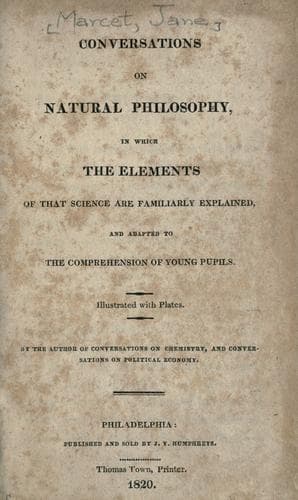
Conversations on Natural Philosophy, in which the Elements of that Science are Familiarly ExplainedMarcet, Mrs. (Jane Haldimand)
Science
Conversations on Natural Philosophy, in which the Elements of that Science are Familiarly Explained
Marcet, Mrs. (Jane Haldimand)
Physics
73. (Pg. 106) How is this accounted for?
74. (Pg. 106) What is meant by the solar and the sidereal day?
75. (Pg. 106) What is the difference in time between them?
76. (Pg. 106) What is the length of the tropical year?
77. (Pg. 107) The solar year is completed before the earth has made a
complete revolution in its orbit, by what is this caused?
78. (Pg. 107) What is this called, and what is represented respecting it
by fig. 1, plate 11?
79. (Pg. 107) By what means can we ascertain the period of a complete
revolution of the earth in its orbit, as illustrated by the fixed star
E, in fig. 1?
80. (Pg. 107) What difference is there in the length of the solar and
sidereal year?
81. (Pg. 107) Why can we not always ascertain the true time by the
apparent place of the sun?
82. (Pg. 108) What would be the greatest difference between solar, and
true time, as indicated by a perfect clock?
CONVERSATION IX.
ON THE MOON.
OF THE MOON'S MOTION. PHASES OF THE MOON. ECLIPSES OF THE MOON. ECLIPSES
OF JUPITER'S MOONS. OF LATITUDE AND LONGITUDE. OF THE TRANSITS OF THE
INFERIOR PLANETS. OF THE TIDES.
MRS. B.
We shall, to-day, confine our attention to the moon, which offers many
interesting phenomena.
The moon revolves round the earth in the space of about twenty-nine days
and a half; in an orbit, the plane of which is inclined upwards of five
degrees to that of the earth; she accompanies us in our revolution round
the sun.
_Emily._ Her motion then must be of a complicated nature; for as the
earth is not stationary, but advances in her orbit, whilst the moon goes
round her, the moon, in passing round the sun, must proceed in a sort of
scolloped circle.
_Mrs. B._ That is true; and there are also other circumstances which
interfere with the simplicity, and regularity of the moon's motion, but
which are too intricate for you to understand at present.
The moon always presents the same face to us, by which it is evident
that she turns but once upon her axis, while she performs a revolution
round the earth; so that the inhabitants of the moon have but one day,
and one night, in the course of a lunar month.
_Caroline._ We afford them, however, the advantage of a magnificent moon
to enlighten their long nights.
_Mrs. B._ That advantage is put partial; for since we always see the
same hemisphere of the moon, the inhabitants of that hemisphere alone,
can perceive us.
_Caroline._ One half of the moon then enjoys our light, while the other
half has constantly nights of darkness. If there are any astronomers in
those regions, they would doubtless be tempted to visit the other
hemisphere, in order to behold so grand a luminary as we must appear to
them. But, pray, do they see the earth under all the changes, which the
moon exhibits to us?
Public-domain text, read in full here on John Shaqi.
Reviews
Reviews
No reviews yet
Be the first to share your thoughts on this work.
Elsewhere in the archive
Join the Discussion
Join the discussion
Sign in to leave a comment or review.
Sign InorCreate an account