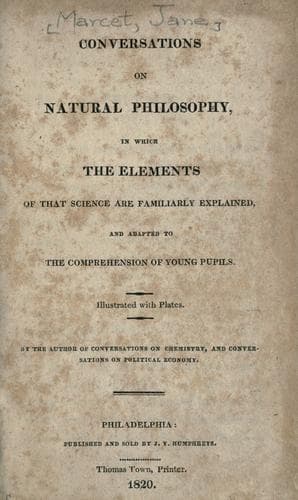
Conversations on Natural Philosophy, in which the Elements of that Science are Familiarly ExplainedMarcet, Mrs. (Jane Haldimand)
Science
Conversations on Natural Philosophy, in which the Elements of that Science are Familiarly Explained
Marcet, Mrs. (Jane Haldimand)
Physics
_Mrs. B._ Yes, few days pass without an eclipse taking place; for among
the number of satellites, one or the other of them are continually
passing either between their primary and the sun; or between the planet,
and each other. Astronomers are so well acquainted with the motion of
the planets, and their satellites, that they have calculated not only
the eclipses of our moon, but those of Jupiter, with such perfect
accuracy, that it has afforded a means of ascertaining the longitude.
_Caroline._ But is it not very easy to find both the latitude and
longitude of any place by a map or globe?
_Mrs. B._ If you know where you are situated, there is no difficulty in
ascertaining the latitude or longitude of the place, by referring to a
map; but supposing that you had been a length of time at sea,
interrupted in your course by storms, a map would afford you very little
assistance in discovering where you were.
_Caroline._ Under such circumstances, I confess I should be equally at a
loss to discover either latitude, or longitude.
_Mrs. B._ The latitude is usually found by taking the altitude of the
sun at mid-day; that is to say, the number of degrees that it is
elevated above the horizon, for the sun appears more elevated as we
approach the equator, and less as we recede from it.
_Caroline._ But unless you can see the sun, how can you take its
altitude?
_Mrs. B._ When it is too cloudy to see the sun, the latitude is
sometimes found at night, by the polar star; the north pole of the
earth, points constantly towards one particular part of the heavens, in
which a star is situated, called the Polar star: this star is visible on
clear nights, from every part of the northern hemisphere; the altitude
of the polar star, is therefore the same number of degrees, as that of
the pole; the latitude may also be determined by observations made on
any of the fixed stars: the situation therefore of a vessel at sea, with
regard to north and south, is easily ascertained. The difficulty is,
respecting east and west, that is to say, its longitude. As we have no
eastern poles from which we can reckon our distance, some particular
spot, or line, must be fixed upon for that purpose. The English, reckon
from the meridian of Greenwich, where the royal observatory is situated;
in French maps, you will find that the longitude is reckoned from the
meridian of Paris.
Public-domain text, read in full here on John Shaqi.
Reviews
Reviews
No reviews yet
Be the first to share your thoughts on this work.
Elsewhere in the archive
Join the Discussion
Join the discussion
Sign in to leave a comment or review.
Sign InorCreate an account