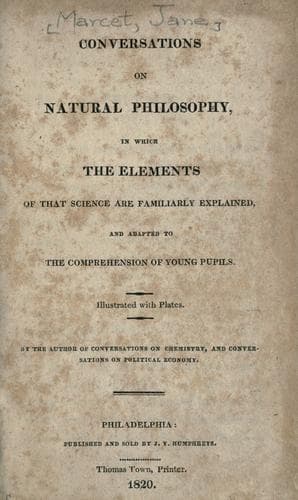
Conversations on Natural Philosophy, in which the Elements of that Science are Familiarly ExplainedMarcet, Mrs. (Jane Haldimand)
Science
Conversations on Natural Philosophy, in which the Elements of that Science are Familiarly Explained
Marcet, Mrs. (Jane Haldimand)
Physics
The rotation of the earth on its axis in 24 hours from west to east,
occasions, you know, an apparent motion of the sun and stars in a
contrary direction, and the sun appears to go round the earth in the
space of 24 hours, passing over fifteen degrees, or a twenty-fourth part
of the earth's circumference every hour; therefore, when it is twelve
o'clock in London, it is one o'clock in any place situated fifteen
degrees to the east of London, as the sun must have passed the meridian
of that place, an hour before he reaches that of London. For the same
reason it is eleven o'clock in any place situated fifteen degrees to the
west of London, as the sun will not come to that meridian till an hour
later.
If then the captain of a vessel at sea, could know precisely what was
the hour at London, he could, by looking at his watch, and comparing it
with the hour at the spot in which he was, ascertain the longitude.
_Emily._ But if he had not altered his watch, since he sailed from
London, it would indicate the hour it then was in London.
_Mrs. B._ True; but in order to know the hour of the day at the spot in
which he is, the captain of a vessel regulates his watch by the sun when
it reaches the meridian.
_Emily._ Then if he had two watches, he might keep one regulated daily,
and leave the other unaltered; the former would indicate the hour of the
place in which he was situated, and the latter the hour at London; and
by comparing them together, he would be able to calculate his longitude.
_Mrs. B._ You have discovered, Emily, a mode of finding the longitude,
which I have the pleasure to tell you, is universally adopted: watches
of a superior construction, called chronometers, or time-keepers, are
used for this purpose, and are now made with such accuracy, as not to
vary more than four or five seconds in a whole year; but the best
watches are liable to imperfections, and should the time-keeper go too
fast or too slow, there would be no means of ascertaining the error;
implicit reliance, cannot consequently be placed upon them.
Recourse, therefore, is sometimes had to the eclipses of Jupiter's
satellites. A table is made, of the precise time at which the several
moons are eclipsed to a spectator at London; when they appear eclipsed
to a spectator in any other spot, he may, by consulting the table, know
what is the hour at London; for the eclipse is visible at the same
moment, from whatever place on the earth it is seen. He has then only to
look at his watch, which he regulates by the sun, and which therefore
points out the hour of the place in which he is, and by observing the
difference of time there, and at London, he may immediately determine
his longitude.
Let us suppose, that a certain moon of Jupiter is always eclipsed at six
o'clock in the evening; and that a man at sea consults his watch, and
finds that it is ten o'clock at night, where he is situated, at the
moment the eclipse takes place, what will be his longitude?
Public-domain text, read in full here on John Shaqi.
Reviews
Reviews
No reviews yet
Be the first to share your thoughts on this work.
Elsewhere in the archive
Join the Discussion
Join the discussion
Sign in to leave a comment or review.
Sign InorCreate an account