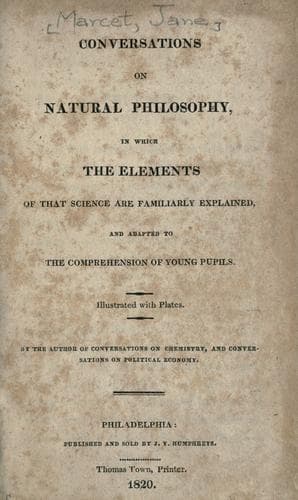
Conversations on Natural Philosophy, in which the Elements of that Science are Familiarly ExplainedMarcet, Mrs. (Jane Haldimand)
Science
Conversations on Natural Philosophy, in which the Elements of that Science are Familiarly Explained
Marcet, Mrs. (Jane Haldimand)
Physics
_Mrs. B._ Yes; fluids, generally speaking, are bodies of less density
than solids. From the slight cohesion, of the particles of fluids, and
the facility with which they slide over each other, it is inferred, that
they have but a slight attraction for each other, and that this
attraction is equal, in every position of their particles, and therefore
produces no resistance to a perfect freedom of motion among themselves.
_Caroline._ Pray what is the distinction between a fluid and a liquid?
_Mrs. B._ Liquids comprehend only one class of fluids. There is another
class, distinguished by the name of elastic fluids, or gases, which
comprehends the air of the atmosphere, and all the various kinds of air
with which you will become acquainted, when you study chemistry. Their
mechanical properties we shall examine hereafter, and confine our
attention this morning, to those of liquids, or non-elastic fluids.
Water, and liquids in general, are scarcely susceptible of being
compressed, or squeezed into a smaller space, than that which they
naturally occupy. Such, however, is the extreme minuteness of their
particles, that by strong compression, they sometimes force their way
through the pores of the substance which confines them. This was shown
by a celebrated experiment, made at Florence many years ago. A hollow
globe of gold was filled with water, and on its being submitted to great
pressure, the water was seen to exude through the pores of the gold,
which it covered with a fine dew. Many philosophers, however, think that
this experiment is too much relied upon, as it does not appear that it
has ever been repeated; it is possible, therefore, that there may have
been some source of error, which was not discovered by the
experimenters. Fluids, appear to gravitate more freely, than solid
bodies; for the strong cohesive attraction of the particles of the
latter, in some measure counteracts the effect of gravity. In this
table, for instance, the cohesion of the particles of wood, enables four
slender legs to support a considerable weight. Were the cohesion
destroyed, or, in other words, the wood converted into a fluid, no
support could be afforded by the legs, for the particles no longer
cohering together, each would press separately and independently, and
would be brought to a level with the surface of the earth.
_Emily._ This want of cohesion is then the reason why fluids can never
be formed into figures, or maintained in heaps; for though it is true
the wind raises water into waves, they are immediately afterwards
destroyed by gravity, and water always finds its level.
_Mrs. B._ Do you understand what is meant by the level, or equilibrium
of fluids?
_Emily._ I believe I do, though I feel rather at a loss to explain it.
Is not a fluid level when its surface is smooth and flat, as is the case
with all fluids, when in a state of rest?
Public-domain text, read in full here on John Shaqi.
Reviews
Reviews
No reviews yet
Be the first to share your thoughts on this work.
Elsewhere in the archive
Join the Discussion
Join the discussion
Sign in to leave a comment or review.
Sign InorCreate an account