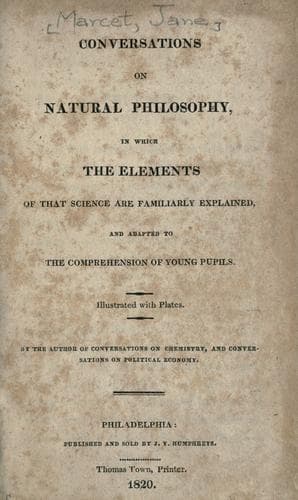
Conversations on Natural Philosophy, in which the Elements of that Science are Familiarly ExplainedMarcet, Mrs. (Jane Haldimand)
Science
Conversations on Natural Philosophy, in which the Elements of that Science are Familiarly Explained
Marcet, Mrs. (Jane Haldimand)
Physics
27. (Pg. 112) From what is longitude reckoned?
28. (Pg. 112) How does the rotation of the earth upon its axis, govern
the time at different places?
29. (Pg. 113) What two circumstances, if known, will enable you to find
your longitude from a given place?
30. (Pg. 113) By what means may a captain find the time at London, and
in the place where his ship may be?
31. (Pg. 113) How may the eclipses of Jupiter's satellites be used to
find the longitude?
32. (Pg. 113) Give an example.
33. (Pg. 114) How will you know whether the longitude is east or west?
34. (Pg. 114) What is meant by the transit of a planet?
35. (Pg. 114) Why can we see transits of Venus and Mercury only?
36. (Pg. 114) By what are tides caused?
37. (Pg. 114) Why is not a similar effect produced on the land?
38. (Pg. 115) In what two parts of the world is it high water at the
same time?
39. (Pg. 115) What circumstances respecting the decrease of attraction
are taken into account, in explaining the tides?
40. (Pg. 115) How are the high tides at A and D, and the low ones at B
and C, in fig. 3. pl. 12, accounted for?
41. (Pg. 116) Has the sun any influence on the tides, and why is it less
than that of the moon?
42. (Pg. 116) What is meant by spring tides, and how are they produced?
43. (Pg. 116) What by neap tides, and how are they caused?
44. (Pg. 116) What circumstances affect the time of the tide in rivers,
bays, &c.?
45. (Pg. 117) Why in the open ocean, is it high water, some hours after
the moon has passed the meridian?
46. (Pg. 117) Why are the tides three-quarters of an hour later every
day?
CONVERSATION X.
ON THE MECHANICAL PROPERTIES OF FLUIDS.
DEFINITION OF A FLUID. DISTINCTION BETWEEN FLUIDS AND LIQUIDS. OF
NON-ELASTIC FLUIDS. SCARCELY SUSCEPTIBLE OF COMPRESSION. OF THE COHESION
OF FLUIDS. OF THEIR GRAVITATION. OF THEIR EQUILIBRIUM. OF THEIR
PRESSURE. OF SPECIFIC GRAVITY. OF THE SPECIFIC GRAVITY OF BODIES HEAVIER
THAN WATER. OF THOSE OF THE SAME WEIGHT AS WATER. OF THOSE LIGHTER THAN
WATER. OF THE SPECIFIC GRAVITY OF FLUIDS.
MRS. B.
We have hitherto confined our attention to the mechanical properties of
solid bodies, which have been illustrated, and, I hope, thoroughly
impressed upon your memory, by the conversations we have subsequently
had, on astronomy. It will now be necessary for me to give you some
account of the mechanical properties of fluids--a science which, when
applied to liquids, is divided into two parts, hydrostatics and
hydraulics. Hydrostatics, treats of the weight and pressure of fluids;
and hydraulics, of the motion of fluids, and the effects produced by
this motion. A fluid is a substance which yields to the slightest
pressure. If you dip your hand into a basin of water, you are scarcely
sensible of meeting with any resistance.
_Emily._ The attraction of cohesion is then, I suppose, less powerful in
fluids, than in solids?
Public-domain text, read in full here on John Shaqi.
Reviews
Reviews
No reviews yet
Be the first to share your thoughts on this work.
Elsewhere in the archive
Join the Discussion
Join the discussion
Sign in to leave a comment or review.
Sign InorCreate an account