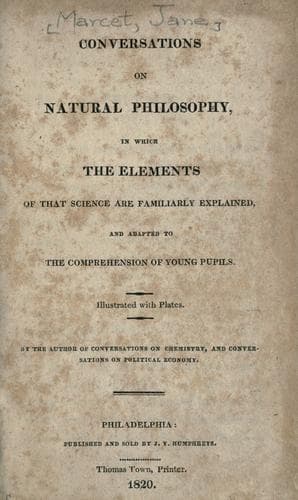
Conversations on Natural Philosophy, in which the Elements of that Science are Familiarly ExplainedMarcet, Mrs. (Jane Haldimand)
Science
Conversations on Natural Philosophy, in which the Elements of that Science are Familiarly Explained
Marcet, Mrs. (Jane Haldimand)
Physics
_Caroline._ And from whence proceeds the pressure of fluids upwards?
that seems to me the most unaccountable, as it is in direct opposition
to gravity.
_Mrs. B._ And yet it is in consequence of their pressure downwards.
When, for example, you pour water into a tea-pot, the water rises in the
spout, to a level with the water in the pot. The particles of water at
the bottom of the pot, are pressed upon by the particles above them; to
this pressure they will yield, if there is any mode of making way for
the superior particles, and as they cannot descend, they will change
their direction, and rise in the spout.
Suppose the tea-pot to be filled with columns of particles of water,
similar to that described in fig. 4., the particle 1, at the bottom,
will be pressed laterally by the particle 2, and by this pressure be
forced into the spout, where, meeting with the particle 3, it presses it
upwards, and this pressure will be continued from 3 to 4, from 4 to 5,
and so on, till the water in the spout, has risen to a level with that
in the pot.
_Emily._ If it were not for this pressure upwards, forcing the water to
rise in the spout, the equilibrium of the fluid would be destroyed.
_Caroline._ True; but then a tea-pot is wide and large, and the weight
of so great a body of water as the pot will contain, may easily force up
and support so small a quantity, as will fill the spout. But would the
same effect be produced, if the spout and the pot, were of equal
dimensions?
_Mrs. B._ Undoubtedly it would. You may even reverse the experiment, by
pouring water into the spout, and you will find that the water will rise
in the pot, to a level with that in the spout; for the pressure of the
small quantity of water in the spout, will force up and support, the
larger quantity in the pot. In the pressure upwards, as well as that
laterally, you see that the force of pressure, depends entirely on the
height, and is quite independent of the horizontal dimensions of the
fluid.
As a tea-pot is not transparent, let us try the experiment by filling
this large glass goblet, by means of this narrow tube, (fig. 6.)
_Caroline._ Look, Emily, as Mrs. B. fills it, how the water rises in the
goblet, to maintain an equilibrium with that in the tube.
Now, Mrs. B., will you let me fill the tube, by pouring water into the
goblet?
_Mrs. B._ That is impossible. However, you may try the experiment, and I
doubt not that you will be able to account for its failure.
_Caroline._ It is very singular, that if so small a column of water as
is contained in the tube, can force up and support the whole contents of
the goblet; that the weight of all the water in the goblet, should not
be able to force up the small quantity required to fill the tube:--oh, I
see now the reason, the water in the goblet, cannot force that in the
tube above its level, and as the end of the tube, is considerably higher
than the goblet, it can never be filled by pouring water into the
goblet.
Public-domain text, read in full here on John Shaqi.
Reviews
Reviews
No reviews yet
Be the first to share your thoughts on this work.
Elsewhere in the archive
Join the Discussion
Join the discussion
Sign in to leave a comment or review.
Sign InorCreate an account