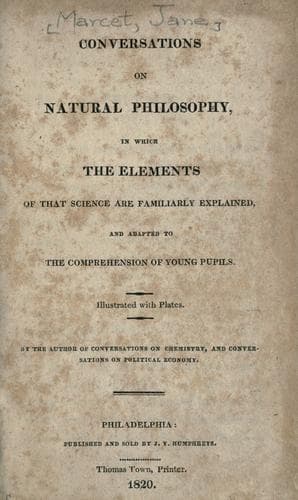
Conversations on Natural Philosophy, in which the Elements of that Science are Familiarly ExplainedMarcet, Mrs. (Jane Haldimand)
Science
Conversations on Natural Philosophy, in which the Elements of that Science are Familiarly Explained
Marcet, Mrs. (Jane Haldimand)
Physics
_Mrs. B._ And if you continue to pour water into the goblet when it is
full, the water will run over, instead of rising above its level in the
tube.
I shall now explain to you the meaning of the _specific gravity_ of
bodies.
_Caroline._ What! is there another species of gravity, with which we are
not yet acquainted?
_Mrs. B._ No: the specific gravity of a body, means simply its weight,
compared with that of another body, of the same size. When we say, that
substances, such as lead, and stones, are heavy, and that others, such
as paper and feathers, are light, we speak comparatively; that is to
say, that the first are heavy, and the latter light, in comparison with
the generality of substances in nature. Would you call wood, and chalk,
light or heavy bodies?
_Caroline._ Some kinds of wood are heavy, certainly, as oak and
mahogany; others are light, as cedar and poplar.
_Emily._ I think I should call wood in general, a heavy body; for cedar
and poplar, are light, only in comparison to wood of a heavier
description. I am at a loss to determine whether chalk should be ranked
as a heavy, or a light body; I should be inclined to say the former, if
it was not that it is lighter than most other minerals. I perceive that
we have but vague notions of light and heavy. I wish there was some
standard of comparison, to which we could refer the weight of all other
bodies.
_Mrs. B._ The necessity of such a standard, has been so much felt, that
a body has been fixed upon for this purpose. What substance do you think
would be best calculated to answer this end?
_Caroline._ It must be one generally known, and easily obtained; lead or
iron, for instance.
_Mrs. B._ The metals, would not answer the purpose well, for several
reasons; they are not always equally compact, and they are rarely quite
pure; two pieces of iron, for instance, although of the same size, might
not, from the causes mentioned, weigh exactly alike.
_Caroline._ But, Mrs. B., if you compare the weight, of equal quantities
of different bodies, they will all be alike. You know the old saying,
that a pound of feathers, is as heavy as a pound of lead?
_Mrs. B._ When therefore we compare the weight of different kinds of
bodies, it would be absurd to take quantities of equal _weight_, we must
take quantities of equal _bulk_; pints or quarts, not ounces or pounds.
_Caroline._ Very true; I perplexed myself by thinking that quantity
referred to weight, rather than to measure. It is true, it would be as
absurd to compare bodies of the same size, in order to ascertain which
was largest, as to compare bodies of the same weight, in order to
discover which was heaviest.
_Mrs. B._ In estimating the specific gravity of bodies, therefore, we
must compare equal bulks, and we shall find that their specific gravity,
will be proportional to their weights. The body which has been adopted
as a standard of reference, is distilled, or rain water.
Public-domain text, read in full here on John Shaqi.
Reviews
Reviews
No reviews yet
Be the first to share your thoughts on this work.
Elsewhere in the archive
Join the Discussion
Join the discussion
Sign in to leave a comment or review.
Sign InorCreate an account